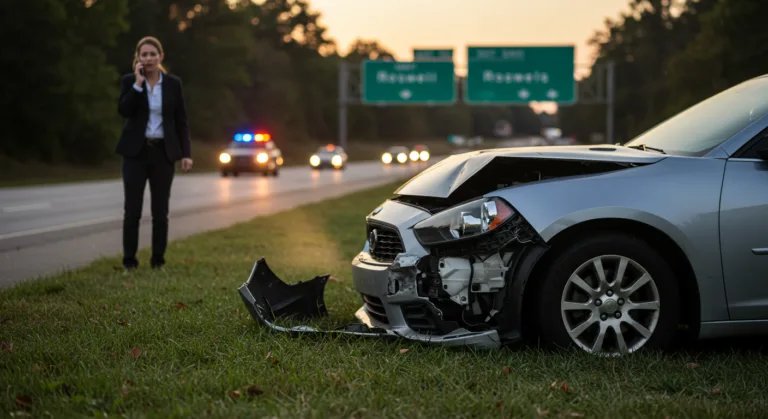
If you’re driving for a service like Amazon Flex, you’re up against some unique challenges after a car wreck. When an Amazon Flex accident in Seattle happens, trying to sort out the aftermath, especially with underinsured motorist claims, gets messy fast. You’re suddenly caught in a maze of personal insurance, Amazon’s commercial policy, and Washington state law, and you need to understand it to protect yourself.
Key Takeaways
- Washington’s required minimums of $25,000 per person and $50,000 per accident for bodily injury liability are almost always too low for a serious collision.
- Amazon Flex gives you contingent liability coverage, which only kicks in after your personal policy either denies your claim or is completely used up.
- Your own Underinsured Motorist (UIM) coverage on your personal auto policy is what will save you when the at-fault driver’s insurance isn’t enough to cover your damages.
- In Washington, drivers hurt in a gig-work accident have a three-year deadline from the date of the wreck to file a personal injury lawsuit.
- You absolutely must document everything, the accident scene, your injuries, and every single related expense, if you want to build a successful underinsured motorist claim.
Understanding Amazon Flex Insurance Coverage in Washington
The insurance for gig drivers, including those with Amazon Flex, is a strange hybrid system. It’s supposed to fill the void between your personal auto insurance (which usually bans commercial driving) and a full commercial policy. Amazon Flex gives its drivers what’s called contingent liability coverage. This means it only starts working in very specific situations, typically after your own car insurance company has officially denied your claim because you were driving for work, or after you’ve hit the limits of your personal policy. A lot of drivers mistakenly think this coverage is primary from the second they start a delivery block. It’s not. That’s a huge distinction when an Amazon Flex accident happens in Seattle.
Amazon’s policy is made up of a few parts: auto liability, uninsured/underinsured motorist (UM/UIM), and complete/collision. The exact terms and limits, however, can change. For example, their liability coverage usually goes up to $1 million for injuries and property damage to other people. But the real catch is the UM/UIM coverage, which often just matches Washington’s bare-minimum requirements or has specific conditions that make it hard to use. This is where drivers find themselves in a bind. If someone with bottom-barrel insurance hits you and your own policy says no because you were on the clock, you’re left with Amazon’s contingent policy, which might have its own frustrating limits or high deductibles.
Washington has its own insurance laws, of course. The Revised Code of Washington (RCW) 46.30.020 requires minimum liability of $25,000 for injuring or killing one person, $50,000 for two or more people, and a tiny $10,000 for property damage. While that’s the legal floor, it’s laughably insufficient for covering real medical bills, lost income, and pain and suffering from a bad wreck, especially in an expensive city like Seattle. This is exactly why underinsured motorist coverage is so necessary for anyone driving for Amazon Flex.
The Role of Underinsured Motorist (UIM) Coverage in Washington
Underinsured Motorist (UIM) coverage is there to protect you when the person who caused the wreck has insurance that can’t cover all of your damages. In Washington, insurance companies have to offer you UIM coverage that matches your liability limits, although you can sign a form to reject it. Rejecting that coverage, particularly if you’re a gig driver, is a mistake I’d never recommend. Just imagine you’re delivering for Amazon Flex near the crazy intersection of 4th and Pine in downtown Seattle when someone blows a red light and T-bones you. Their policy has the state minimum $25,000 for bodily injury, but your first hospital bill alone is over $75,000. Without UIM, you’re on the hook for that $50,000 difference.
UIM coverage works in two main ways: it covers your medical bills, lost income, and pain and suffering (this is UIM-BI, for bodily injury), and it can also cover your car’s repairs (UIM-PD, for property damage). The “underinsured” part means your UIM policy pays the gap between the at-fault driver’s lowball coverage and your own UIM limits, up to whatever your policy max is. So, if your UIM-BI limit is $100,000 and the other driver has a $25,000 policy, your UIM could pay you up to another $75,000 after their insurance pays out, assuming your damages are that high. This ability to “stack” coverage is what makes UIM so powerful for people who spend a lot of time on the road.
It’s also worth knowing the difference between UIM and Uninsured Motorist (UM) coverage. UM is for when the at-fault driver has zero insurance. Insurance companies usually sell them together as a UM/UIM package. With so many uninsured drivers on Seattle’s roads, and even more people carrying only the legal minimums, having a strong UM/UIM policy isn’t just a good idea. It’s a professional necessity. The rules for how UIM claims work in Washington are laid out in RCW 48.22.030, which gets into the details of policy requirements and how they interact.
Working through the Claims Process After an Amazon Flex Accident
When an Amazon Flex accident in Seattle does happen, the claims process is a slog because of all the insurance layers. After you’ve made sure everyone is safe and gotten medical care, your first step is to report the crash to Amazon Flex through their driver support app. You also have to report it to your personal auto insurance carrier. Just be ready for your personal insurer to push back. They will likely deny the claim if they confirm you were engaged in commercial activity. That denial is usually what forces Amazon’s contingent policy to finally get involved.
Documentation is everything. I mean everything. Take photos of the accident scene, all the vehicle damage, and any injuries you can see. You need to get contact information from everyone involved, especially any witnesses. If the police show up, get the police report number. Keep a detailed log of every doctor’s appointment, therapy session, prescription, and any other expense you pay for out-of-pocket because of the crash. This also means tracking your lost income, so you need to document every single delivery block you missed and what you would have earned. Proving the full value of your damages, particularly for lost wages, is nearly impossible without this kind of thorough paperwork.
After you’ve put Amazon and your personal insurer on notice, and assuming your personal policy denies the claim, you’ll start dealing with Amazon’s insurance company. If the other driver was underinsured, you’ll then need to open a UIM claim with your own insurance company. This is where it gets weird. Even though it’s your own policy, your insurer will treat you like an adversary in a UIM claim. They will scrutinize your injuries and damages just as hard as they would if you were suing someone else. They have a direct financial incentive to pay you as little as possible. Is it any wonder why having an experienced legal advocate isn’t just helpful, but often the only way to protect your rights and get paid fairly?
Common Challenges in Underinsured Motorist Claims for Gig Drivers
Gig drivers run into the same few problems over and over again when they file underinsured motorist claims. The first big one is the “business use” exclusion that’s buried in most personal auto policies. Your insurer will argue that since you were driving for work, your personal policy doesn’t apply. While Amazon’s contingent policy is supposed to be the safety net, you can get stuck in a long, drawn-out fight about which policy is primary, leaving you with a pile of medical bills and no income.
Proving your lost income is another headache. Unlike someone with a salary, a gig driver’s income goes up and down. Insurance adjusters love to average your earnings in a way that lowballs your actual losses. You’ll need to produce detailed records, your earnings statements from the Amazon Flex app, corresponding bank statements, and tax returns, to paint an accurate picture of what you lost. I can’t say it enough: you have to keep good financial records if you drive for any gig service. If you don’t, your lost wage claim is just guesswork, and the insurer will tear it apart.
On top of that, insurers in UIM claims frequently question how bad your injuries are or whether you really needed all that medical care. They might hire their own doctor to say your injuries were from an old problem or that your physical therapy was excessive. This is where detailed medical records from your doctors, with clear treatment plans and prognoses, become your best evidence. Having a medical professional state clearly that your injuries are a direct result of the accident is critical. The insurance company’s goal is to close your file for the lowest amount possible, and they have a whole playbook of tactics to get there.
The Statute of Limitations and Legal Representation
In Washington State, the statute of limitations for filing a personal injury claim which includes wrecks from an Amazon Flex accident in Seattle, is three years from the date of the collision. That deadline is set by RCW 4.16.080. Three years sounds like a lot of time, but investigating a crash, collecting all the medical records, proving lost wages, and fighting with insurance companies can easily eat up that time. If you wait too long, evidence gets lost, witness memories go fuzzy, and the financial pressure can force you into a bad decision. You should always talk to a lawyer as soon as you can after an accident, even if you think your injuries are minor.
Hiring a lawyer is especially important for underinsured motorist claims. An attorney can help you make sense of the tangled mess of your personal policy, Amazon’s contingent coverage, and the at-fault driver’s insurance. They will take over all the calls and emails with the insurance adjusters, who are professionally trained to get you to accept less money. A good lawyer will methodically collect the evidence, accident reports, medical bills, and even expert opinions if needed, to build a powerful case that proves your damages. They negotiate for you to make sure every single loss, from your hospital bills and lost wages to your pain and suffering, is properly valued. If the insurance company refuses to offer a fair settlement, your lawyer can file a lawsuit to get you the compensation you deserve.
The details of UIM law, especially when mixed with the confusing terms of gig economy insurance, are not something you should try to figure out by yourself. An experienced personal injury attorney in Seattle will already have a deep knowledge of Washington’s insurance rules and the tricks the insurance companies use. They can stop you from making common mistakes that will sink your claim, like giving a recorded statement to an adjuster without legal advice or grabbing a quick, lowball settlement check out of desperation. I’ve seen too many drivers try to go it alone, only to find out months later that they’ve signed away their right to get fully compensated.
If you’re dealing with the fallout of an Amazon Flex accident in Seattle with an underinsured driver, you need a complete plan to protect your health and your finances. Understanding the layered insurance policies and Washington’s legal framework isn’t just a good idea, it’s the only way to get fair compensation.
What is the “business use” exclusion in personal auto insurance?
It’s a clause in most personal auto insurance policies that allows the company to deny your claim if you were using your car for work, like making deliveries for Amazon Flex, when the accident happened. It’s often the first hurdle you’ll face when you try to file a claim.
How does Amazon Flex’s contingent insurance work in Washington?
Amazon Flex provides what’s called contingent insurance. It’s a backup policy that’s only supposed to activate after your personal car insurance has officially denied your claim for commercial use or after your personal policy’s limits have been paid out. It is not your primary coverage.
Can I still file an underinsured motorist claim if Amazon Flex’s policy also has UIM coverage?
Yes. You can and should still pursue a UIM claim through your personal auto policy. How your policy and Amazon’s policy interact can get complicated, since it involves figuring out the right order of coverage, and a lawyer can help you develop the right strategy to get the most from all available policies.
What kind of documentation is most important after an Amazon Flex accident?
The most important things are photos of the crash scene and car damage, all of your medical records and bills, a log of every expense related to the accident, and solid proof of your lost income (like Amazon Flex earnings reports and bank statements).
What is the statute of limitations for filing a personal injury claim in Washington after a car accident?
In Washington, you have three years from the date of the wreck to file a personal injury lawsuit. This deadline is set by RCW 4.16.080.