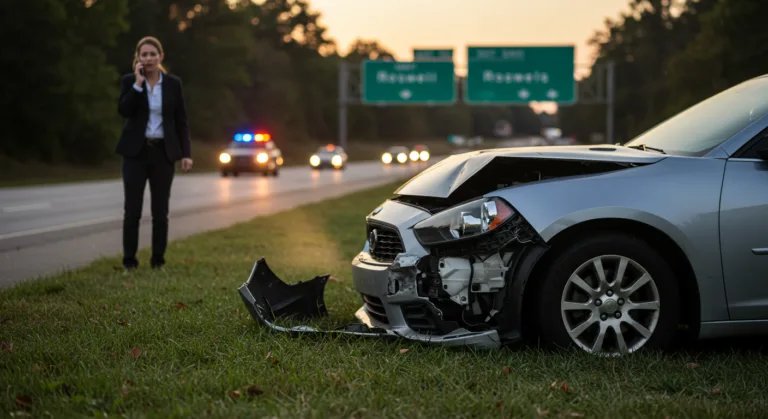
Hit-and-runs are a nasty, persistent problem in Georgia, the GDOT reports over 30,000 of these crashes every year. For a victim in a place like Marietta, getting fair compensation after the other driver vanishes feels impossible. But it’s not. A recent case shows exactly why: the victim recovered $300,000, not from the driver who fled, but from their own uninsured motorist policy. This proves that the common wisdom about these claims being worthless is just plain wrong.
Key Takeaways
- Georgia law makes insurers offer you uninsured motorist (UM) coverage, which is your main tool after a hit-and-run.
- A big UM policy, especially one where you’ve “stacked” coverage, can lead to serious money, like the $300,000 recovered in a recent Marietta case.
- The police report is your foundation. You need it to document vehicle damage, debris on the road, and any witness accounts to prove a hit-and-run happened.
- You have to tell your insurance company about the crash right away, usually within 30 days, or you could lose your right to a UM claim.
- Getting the most out of a UM claim, especially when the insurer fights back, usually means you need a lawyer who knows how to work the system.
The Startling Statistic: 1 in 5 Georgia Crashes Involve an Uninsured Driver
About 1 in 5 drivers on Georgia’s roads don’t have insurance, according to the state’s own Office of Commissioner of Insurance and Safety Fire. This is a shocking number, and it’s the single best reason to have strong uninsured motorist (UM) coverage. When a driver hits you and flees the scene, they are, for all practical purposes, an uninsured motorist. For anyone driving in Cobb County on I-75 near the Delk Road exit or just on Cobb Parkway, this is a daily reality. That $300,000 recovery in Marietta wasn’t a lottery win, it happened because the victim had enough UM protection to cover a serious injury.
From my experience, this means UM coverage is a fundamental safeguard, not some extra you can skip. So many clients I talk to see it as just another charge on their bill and go for the bare minimum, which is a mistake. The Marietta case shows why that thinking is dangerous. If that victim only had Georgia’s minimum $25,000 UM limit, they would’ve been stuck paying for their own medical bills and lost income. Your insurance company isn’t in the business of telling you to buy more coverage. You have to be your own advocate when you’re buying the policy in the first place.
The $300,000 Recovery: Proof of Stacked UM Coverage
Let’s look at how that $300,000 recovery was even possible. It comes down to a critical part of Georgia insurance law: “stacking” uninsured motorist coverage. The victim in this Marietta case had more than one car on their policy, and each car had its own UM coverage. Georgia law (specifically O.C.G.A. Section 33-7-11(b)(1)(B)) lets you combine, or stack, the UM coverage from different cars on one policy, or even from different policies in your home. While I can’t share the person’s policy details, a $300,000 payout points directly to stacked coverage, maybe they had three cars with $100,000 of UM on each. A recovery this large is basically impossible with a standard, single-vehicle policy that often caps out at $25,000.
This case blows up the myth that UM coverage is a simple, fixed amount. The truth is, its value is tied directly to the limits you choose and whether you knew enough to stack them. A lot of my clients don’t even know stacking is an option that can multiply their protection. A quick chat with an agent about this can make a huge difference. We see heartbreaking situations where people with severe injuries, the kind that require long-term care at a place like Wellstar Kennestone Hospital, are stuck with a tiny settlement because they never asked about stacking. The insurer’s default is often to sell you a non-stacked policy, and that single detail can be a six-figure mistake.
The Important Role of the Police Report: Evidence in Hit-and-Run Cases
In any successful hit-and-run claim, including that Marietta case, everything starts with the police report. To get a UM claim paid, you need independent proof that a hit-and-run actually occurred. The law backs this up. O.C.G.A. Section 33-7-11(b)(2) requires physical contact between the cars, or at least an independent witness if there wasn’t contact. The Marietta Police Department’s report would have been the core piece of evidence, describing what the victim said but also documenting physical proof like paint transfer, broken bits of plastic, or shattered glass at the scene. A good report gives you the ammunition to prove your case to the insurance carrier. Without it, your claim can be dismissed as a “phantom vehicle” incident, which is incredibly difficult to win.
In my practice, I can tell you that the biggest roadblock in these cases is a thin or nonexistent police report. If the cops show up and just write it up as a single-car wreck because the other guy is gone, your UM carrier will deny the claim in a heartbeat. They’ll argue there’s no proof another vehicle was even there. This is why you have to act fast. Call 911 immediately, no matter how minor your injuries seem, and make sure the Cobb County or Marietta PD officers document everything. Are they doing a thorough job? You also need to take your own photos right then and there, your damaged car, the other car’s debris on the ground, anything. You can’t just wait for the police to do it all for you.
The 30-Day Rule: Timely Notification to Your Insurer
Here’s another detail that separates a successful UM claim from a failed one: telling your insurance company about it quickly. While there isn’t always a hard 30-day legal deadline for every step, most UM policies have a clause that requires “prompt notification.” If you wait too long, the insurance company can argue that your delay hurt their ability to investigate, giving them a reason to deny your claim. For the $300,000 Marietta case to succeed, you can bet the victim or their lawyer got on the phone with the insurer almost immediately after the crash.
This is a trap so many people fall into. You’re shaken up, you’re hurt, maybe you’re just hoping the police find the other driver. A few days go by, then a few weeks. Meanwhile, you’ve given your insurance company, a business that wants to limit what it pays out, a perfect excuse. I tell every client the same thing: after you call the police, your very next call should be to your own insurance company to report the incident. Don’t wait for the police report to be finished. Don’t wait until you’ve finished all your doctor’s appointments. A simple phone call to get the claim number is all it takes to protect your rights. Not doing it is like shooting yourself in the foot.
Challenging Conventional Wisdom: Hit-and-Run Claims Are Not Always “Small Potatoes”
There’s this idea out there that hit-and-run claims are always “small potatoes,” that you can’t get much because there’s no at-fault driver’s insurance to go after. People assume you’ll be lucky to get your immediate medical bills covered, with nothing for pain and suffering. The $300,000 Marietta recovery completely destroys that myth. It’s concrete proof that with the right UM coverage and proper follow-through, hit-and-run victims can absolutely recover damages for everything, medical bills, lost income, and significant pain and suffering.
I get frustrated with this myth because I see injured people accept lowball offers all the time because they believe it. The reality is that your own UM policy becomes the at-fault driver’s insurance. If you have $300,000 in stacked UM coverage, then that’s the pot of money available to pay for your damages, just as if the phantom driver had a $300,000 liability policy. The fight, then, is proving your damages to your own insurer, which can be just as much of a battle as fighting a third-party company. Their adjusters have the same job: keep payouts low. That’s why getting a lawyer is so important. A good attorney knows how to package medical records, document lost wages, and argue for the real value of your pain and suffering, even when the fight is with your own insurance company.
If you’re in a hit-and-run in Marietta or anywhere else in Georgia, the first thing you need to do is figure out your uninsured motorist coverage. Don’t write off your claim as a lost cause. Check your policy, document every single thing, and get professional advice to make sure you get what you’re owed. Having critical documents for your claim is the first step. And for people in Atlanta, it’s also worth knowing how Atlanta rideshare injury claims work, since hit-and-runs can involve any driver on the road.
What is uninsured motorist (UM) coverage in Georgia?
It’s insurance that protects you when the other driver has no insurance, or when you’re the victim of a hit-and-run. Your UM policy steps into the shoes of the at-fault driver and pays for your medical bills, lost wages, and pain and suffering up to the limits you bought.
Can I stack UM coverage in Georgia?
Yes, and you should. Georgia law lets you combine the UM coverage from multiple cars on one policy (or even separate policies in your house). This is how you turn a small policy into a large one that can actually cover a serious injury.
What evidence do I need for a hit-and-run UM claim?
You need proof. The best proof is a police report that confirms a hit-and-run, evidence of physical contact (like paint scuffs or parts left behind), or an independent witness. Take photos of everything at the scene yourself.
How long do I have to report a hit-and-run to my insurance company in Georgia?
Report it as soon as you can after calling the police. Your policy has a “prompt notification” clause. Waiting weeks can give the insurer an excuse to deny your claim, so don’t delay. A quick phone call is enough to get the ball rolling.
Will my insurance rates go up if I make a UM claim for a hit-and-run?
Generally, no. In Georgia, it’s illegal for an insurer to raise your rates for an accident that wasn’t your fault, and a hit-and-run is clearly not your fault. While every policy is different, you shouldn’t be penalized for using the coverage you paid for.