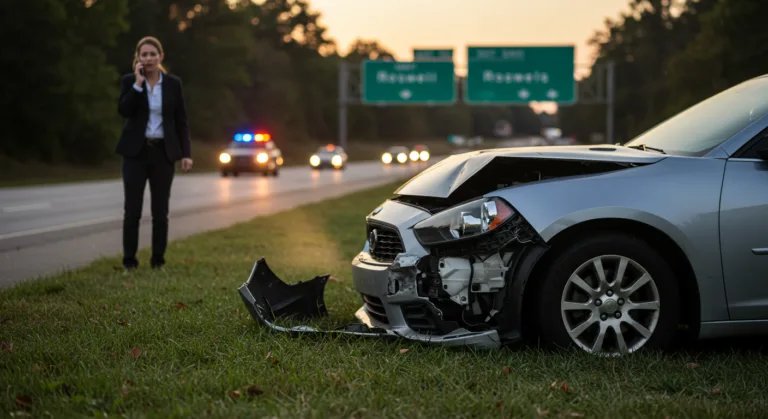
When a DoorDash driver in Denver gets into an accident, it’s not the crash that ruins them. It’s the pile of unpaid medical bills and the non-stop calls from collections that follow. Figuring out how to recover financially means knowing the legal traps and insurance gaps that are unique to gig work. Your main options are a claim against the at-fault driver’s insurance, a complex claim through the delivery company’s policy, or, if you have it, your own Uninsured Motorist coverage.
Key Takeaways
- Insurance companies often deny claims from gig drivers like DoorDashers because they’ll argue you were ‘on the clock’ for a commercial job, which your personal policy doesn’t cover.
- Photos of the cars and scene, copies of every medical bill, and proof of your lost income are the actual evidence you’ll use to build a personal injury claim and get paid.
- Going after the negligent driver’s insurance directly is usually the fastest path to getting fully compensated for your medical bills and other losses, rather than getting stuck in the rideshare company’s policy maze.
- You have to follow Georgia’s specific laws, like the two-year deadline for personal injury lawsuits in O.C.G.A. Section 9-3-33, or your case is dead on arrival.
- Many personal injury lawyers work on a contingency fee, which just means they take a percentage of the settlement, so you can get legal help without paying anything upfront.
### The Unseen Battle: How Delivery Accidents Cause Financial Ruin The convenience of the gig economy is built on the risks that drivers take every day. While accidents happen to everyone on Georgia’s roads, when a delivery driver gets hit, the insurance mess starts immediately, leading to a financial nightmare. Your income disappears overnight. Medical bills from the ER and specialists begin to stack up. Soon, the fight against collection agencies starts. It’s about your financial survival. We see it all the time, a fender bender that should be straightforward turns into a full-blown crisis because an insurance company uses the ‘commercial use’ exclusion to deny the claim, or they make a settlement offer that doesn’t even cover the ambulance ride. Take Maria, a 38-year-old single mom from DeKalb County who drove for a delivery app. In October 2025, she was T-boned by a distracted driver near Peachtree Road and Lenox Road in Atlanta. She ended up with a fractured arm, whiplash, and bad bruising. Her personal auto insurance immediately said no, pointing to their commercial use exclusion. The delivery app’s insurance was a maze of corporate red tape, leaving her with bills from Grady Memorial Hospital piling up and no way to earn money. Her solid credit score started to tank as collectors began calling her every day. Within a few weeks, her medical expenses shot past $25,000. ### Case Study 1: The Denied Claim and the Determined Driver Injury Type: Fractured radius, cervical sprain (whiplash), severe contusions.
Circumstances: Maria, delivering food, was struck by a driver who ran a red light. The other driver was insured, but Maria’s personal policy had a commercial use exclusion. The delivery company’s insurance, a third-party liability policy, offered minimal initial coverage, far below her actual damages.
Challenges Faced:
- Insurance Denials: Both Maria’s personal auto insurer and the delivery company’s primary policy initially denied complete coverage, creating a gap in immediate financial support.
- Lost Wages: Maria, unable to work for three months, lost an estimated $7,500 in income, impacting her ability to pay rent and other living expenses.
- Medical Debt Accumulation: Bills from emergency services, orthopedic specialists, and physical therapy quickly accumulated, leading to aggressive collection efforts.
- Working through Complex Policies: The intricacies of personal versus commercial auto insurance, and the specific terms of gig economy platform policies, were overwhelming for Maria.
Legal Strategy Used: We attacked this on multiple fronts. First, we fired off letters of representation to every insurance carrier involved, including the one for the guy who hit her. Then we built a massive file of her medical records, doctor’s notes, MRI results, PT logs, to prove how bad her injuries were and how they’d affect her long-term. We calculated every dollar of her lost income. A big part of the fight was arguing that the delivery company’s supplemental policy had to provide coverage since she was in the middle of a “delivery period,” but the most direct path to getting her paid was always a claim against the at-fault driver. In Georgia, O.C.G.A. Section 33-7-11 makes it clear: the at-fault driver’s insurance pays first. Settlement Outcome: The other driver’s insurer didn’t want to see us in Fulton County Superior Court. After a lot of negotiation, they agreed to a settlement of $85,000. This was enough to cover all her medical bills, her lost income, her car, and her pain and suffering. The whole thing took about 9 months. If Maria had accepted the insurance company’s first lowball offer, she would have been left with tens of thousands in medical debt.
Were you in a car accident?
Insurance adjusters are trained to settle fast and pay less. Most car accident victims leave an average of $32,000 on the table.
### Case Study 2: The Hit-and-Run and the Uninsured Motorist Injury Type: Traumatic brain injury (concussion), severe lumbar strain, multiple lacerations.
Circumstances: David, a 28-year-old college student driving for a food delivery service in Athens, Georgia, was involved in a hit-and-run accident on Prince Avenue in March 2025. The at-fault vehicle fled the scene, and despite police efforts, was never identified. David’s personal insurance carried only minimum liability coverage, and he had opted out of uninsured motorist (UM) coverage to save money. The delivery platform’s policy also had limitations for hit-and-run incidents where the at-fault driver was unknown.
Challenges Faced:
- No Identifiable At-Fault Driver: The absence of a liable third party made traditional personal injury claims difficult.
- Lack of UM Coverage: David’s personal policy offered no recourse for injuries caused by an uninsured or unidentified driver.
- Concussion Recovery: His traumatic brain injury (concussion) required extensive neurological evaluation and cognitive therapy, leading to significant medical costs and academic disruption.
- Mental Health Impact: The stress of the accident, coupled with financial worries, led to anxiety and depression, further complicating his recovery.
Legal Strategy Used: This was a tough case. With no at-fault driver to sue, we had to get creative. We canvassed local businesses on Prince Avenue for security footage, but nothing came of it. So we pivoted and started digging through the fine print of the delivery company’s insurance agreements, the stuff nobody ever reads. We found a clause for an occupational accident insurance (OAI) policy. It’s not as good as a real auto policy, but it offered some benefits for medical bills and lost wages without needing to prove fault. It’s a benefit most drivers don’t even know exists. We then used those OAI benefits as use to negotiate down what he owed his health insurance and doctors. Settlement Outcome: David got $40,000 from the platform’s OAI policy, which paid for most of his medical care and gave him some income while he was out of school. After we negotiated with all his medical providers, his final out-of-pocket cost was only about $5,000. It was a 14-month slog because of the OAI claim’s complexity, but it kept him from being buried in debt. It just goes to show that you have to read every single insurance policy available to you. ### Case Study 3: The Rear-End Collision and Pre-Existing Conditions Injury Type: Aggravated herniated disc (L4-L5), shoulder impingement.
Circumstances: Sarah, a 55-year-old part-time delivery driver in Savannah, Georgia, was rear-ended at a low speed on Abercorn Street in July 2025. She had a history of lower back issues, including a pre-existing herniated disc, which was significantly worsened by the collision. The at-fault driver’s insurance company immediately attempted to deny or severely limit her claim, arguing her injuries were pre-existing and not directly caused by the accident.
Challenges Faced:
- Pre-Existing Condition Argument: The core challenge was proving the accident aggravated her pre-existing back condition, rather than simply being a continuation of it.
- Low-Impact Collision: The relatively low speed of the collision made it harder to convince the insurance company of the severity of her injuries.
- Medical Documentation: Sarah needed to undergo extensive diagnostics, including new MRIs and consultations with spine specialists, to differentiate between her baseline condition and the post-accident aggravation.
- Insurance Company Tactics: The at-fault insurer used delaying tactics, requesting multiple independent medical examinations (IMEs) and questioning the necessity of her treatments.
Legal Strategy Used: The insurance company’s entire defense was “her back was already bad,” so our whole strategy was about clear medical evidence. We had Sarah’s own doctors write detailed reports comparing her old MRIs to the new ones, explicitly stating that the crash on Abercorn Street caused a new or significantly worsened injury. Then we hit them with Georgia’s “eggshell skull” rule, a legal principle that says you take your victim as you find them. It means that even if Sarah was more susceptible to injury because of her back, the person who hit her is still responsible for all the damage their negligence caused. Settlement Outcome: They fought us for 18 months, but their pre-existing condition defense was weak against the medical evidence. We secured a $110,000 settlement for Sarah to cover her spinal injections, physical therapy, and pain and suffering. It’s a classic example of how you can win these aggravation cases, but only if you can get the specific medical proof to back it up. ### Understanding Georgia’s Legal Framework for Accident Claims In Georgia, you have specific deadlines and rules for injury claims. The big one is the statute of limitations, O.C.G.A. Section 9-3-33, which generally gives you only two years from the date of the injury to file a lawsuit. Miss it, and your claim is worthless. For workers’ comp, the deadlines are even tighter (often 30 days to notify an employer), but gig drivers are stuck in a legal gray area. Courts are constantly issuing new rulings on whether drivers are employees or contractors, which changes the game for workers’ comp eligibility. Negligence is the whole ballgame in these cases. To get any money, you have to prove the other driver was careless, texting, speeding, running a light, and that their carelessness caused your injuries. That’s why the police report, photos from the scene, witness phone numbers, and your medical records aren’t just paperwork. They are the building blocks of your negligence claim that force an insurance company to pay.
### The Impact of Unpaid Medical Bills and Collections The endless calls from collections agencies about unpaid medical bills are often more stressful than recovering from the accident itself. Hospitals don’t wait long before selling your debt to third-party collectors. These agencies will then bombard you with calls at all hours and send threatening letters. The next thing you know, the negative marks they report to the credit bureaus have destroyed your credit score, making it hard to get a car loan or even rent an apartment. You have rights when dealing with collectors, especially when the debt is tied to an ongoing personal injury claim that you’re disputing. When an attorney sends a “letter of protection” to a hospital, it tells them we will pay the bill out of a future settlement, which is usually enough to get them to stop collection activities while the case is pending. ### What to Do When You’re Drowning in Paperwork For a delivery driver who’s been in a wreck, the combination of confusing insurance policies, claim denials, and mounting medical debt is overwhelming. Getting a lawyer who has handled these specific gig-work cases is effective because they already know the insurance company’s playbook and how to counter it. A good attorney takes over the negotiations with insurance adjusters and handles the mountains of paperwork, fighting for a real settlement. This frees the driver to focus on recovering instead of spending all day fielding calls from bill collectors. Local knowledge about specific problem intersections is a big deal when arguing fault in Atlanta DoorDash crashes. Also, knowing when you can hold a city responsible for dangerous road conditions can open up another source of recovery, which is covered in this article on Georgia road hazards. ### FAQ Section
What’s the first thing a delivery driver should do after a crash in Georgia?
First, get yourself to a safe place and call 911. This gets police and an ambulance on the way. Get the insurance and contact info from the other driver. Then, use your phone to take pictures and videos of everything, the damage to both cars, the positions of the vehicles, skid marks, and your injuries. Go to the ER or an urgent care clinic right away, even for what feels like a minor ache. After that, notify your delivery app about the accident and call a personal injury lawyer before you talk to any insurance adjusters.
What’s the difference between my personal car insurance and the gig app’s policy?
Your personal auto policy almost certainly has a “commercial use exclusion,” which is a loophole the insurer will use to deny your claim if you were logged into the app. The gig platform’s insurance is supposed to cover you, but the amount of coverage changes depending on your status. Were you waiting for a delivery, on your way to a pickup, or driving to the customer? Knowing which “period” you were in is everything, because it determines which policy and what coverage limits apply. It’s a complicated system designed to limit their payout.
Can I still sue the other driver if I was working for a delivery app?
Yes, absolutely. Your primary personal injury claim is against the at-fault driver who was negligent and hit you. Their auto insurance is the main source for covering your medical expenses, lost income, and pain and suffering. This is a separate fight from the one you’ll have with your own insurer and the delivery company’s insurance carrier.
What happens if the driver who hit me was uninsured or it was a hit-and-run?
If the at-fault driver has no insurance or they fled the scene, your options get tricky. Your best bet is your own Uninsured/Underinsured Motorist (UM/UIM) coverage on your personal policy, if you have it. If you don’t, the next step is to dig into the delivery app’s policies to see if they offer any specific UM coverage or a separate Occupational Accident Insurance (OAI) policy. Getting money in these situations means investigating every possible insurance source, because there’s no easy payout.
How can I afford a lawyer if I’m a delivery driver with no income?
Most personal injury lawyers, us included, work on a contingency fee. You don’t pay us anything out of your pocket. Our fee is a percentage of the money we recover for you in a settlement or from a jury. If we don’t win your case, you owe us nothing. This system gives everyone access to the courts, not just people who can afford to write a big check for legal fees.