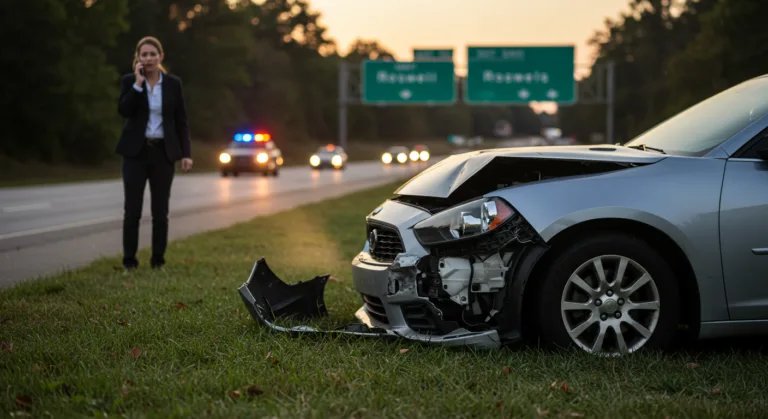
Working as an Instacart shopper in Savannah is a flexible gig, but it’s not without risk. You can get hurt in a slip and fall inside a grocery store or a car wreck during a delivery, leaving you injured with medical bills piling up. Trying to handle the aftermath, especially if you make a few common mistakes, means you need to know your rights, like your right to file a claim against a negligent store or driver. A lot of shoppers don’t realize how complicated these cases are and make mistakes that wreck their chances for fair compensation, like giving a recorded statement to an adjuster or not realizing they can claim against multiple policies. Getting your claim handled correctly means avoiding those traps.
Key Takeaways
- Get photos of the scene and contact info from witnesses right after an accident. This evidence is the foundation of your claim, because scenes get cleaned up and people’s memories get fuzzy.
- See a doctor right away, even if you think you’re okay. This creates a medical record that proves the injury happened when and how you said it did, which is ammunition against an insurer trying to argue it happened some other time.
- You have to know the difference between your status as an independent contractor and an employee’s rights under Georgia law. This determines everything about your claim’s eligibility, whether you’re suing a store, another driver, or tapping into Instacart’s own accident policy.
- Talking to a personal injury lawyer from the start can stop you from making case-killing mistakes, like accepting a lowball offer before you even know the full extent of your injuries.
- Never give a recorded statement to an insurance adjuster without your lawyer. They are trained to ask leading questions designed to get you to admit fault or downplay your injuries, and they will use your own words against you.
Case Study 1: Slip and Fall at a Grocery Store
In January 2025, a 38-year-old Instacart shopper had a bad slip and fall while working in Savannah’s Victorian District. She was wrangling a heavy cart down a produce aisle in a big grocery store near Forsyth Park when she hit a puddle of water from a leaky refrigeration unit. There were no wet floor signs anywhere nearby. The fall left her with a fractured wrist and a concussion, landing her in the ER at Memorial Health University Medical Center and leading to a lot of orthopedic follow-ups.
Circumstances and Initial Challenges
The shopper (we’ll call her Sarah) did the right thing and told the store manager immediately, who had her fill out an incident report. But she didn’t get any pictures of the puddle or the names of other shoppers who saw it happen. At first, she figured the store’s insurance would just take care of her medical bills and lost pay. Nope. The store’s insurer denied her claim fast, saying she didn’t have enough proof the store was negligent and that she should have just watched where she was going. They tried to use the “open and obvious” defense, a classic move in these kinds of premises liability cases.
Legal Strategy and Outcome
Once Sarah realized she was in a fight, she hired a lawyer. Our whole strategy was proving the store was negligent. We subpoenaed the store’s surveillance video, and sure enough, it showed the leak had been sitting there for a good 30 minutes before Sarah fell, with employees walking right past it. We also tracked down a former employee who told us that specific refrigeration unit was always having problems. Better yet, the store’s own maintenance logs, which we got through discovery, confirmed the history of issues. Our argument was simple: the store knew or should have known about the dangerous condition and did nothing about it, which is a breach of their duty of care to customers under Georgia law (O.C.G.A. Section 51-3-1). We also made a huge deal about her lost income, because with a busted wrist, she couldn’t work for almost three months and was struggling to make rent.
The case went to mediation in October 2025. Once the grocery store’s insurer saw the video and maintenance logs, they knew they were in trouble. They agreed to a settlement. Sarah got $85,000, which covered her medical treatment, all the money she lost from not working, and her pain and suffering. The whole thing took about 10 months. The lesson here is that you have to grab evidence immediately and never let an insurance company’s first “no” be the final word.
Case Study 2: Rear-End Collision During Delivery
A 55-year-old shopper, John, was finishing up a delivery in Savannah’s Ardsley Park neighborhood in April 2025. He was stopped at a red light at Abercorn and Victory Drive when a distracted driver slammed into the back of his car. The crash gave John a bad whiplash injury, severe lower back pain, and a herniated disc that ended up needing epidural steroid injections and a ton of physical therapy. He was in his own car, covered by his personal auto policy.
Circumstances and Initial Challenges
The at-fault driver’s insurance company admitted their driver caused the wreck, but that’s where their cooperation ended. They immediately started fighting over how badly John was hurt, arguing that his pre-existing degenerative disc disease was the real source of his pain, not the crash. They threw a lowball offer of $7,500 at him, which wouldn’t even cover his first trip to the ER. John was so overwhelmed with doctor’s appointments and the adjuster’s hardball tactics that he almost took it, thinking he had no other choice.
Legal Strategy and Outcome
John called our firm in June 2025. Our plan was to show that even though John had a pre-existing condition, the wreck made it dramatically worse and tanked his quality of life. This is a basic legal idea called the “eggshell skull” rule, the defendant has to take the victim as they find them, pre-existing conditions and all. We had John’s orthopedic surgeon and pain management doctor write detailed reports that drew a straight line from the collision’s trauma to the flare-up of his back problems. We also documented his lost earnings, since his back pain meant he couldn’t lift heavy groceries and had to cut his Instacart hours way back. We even looked into Instacart’s occupational accident insurance, but those policies can have really specific and tricky requirements.
We filed a lawsuit in Chatham County Superior Court and went into discovery. During his deposition, the at-fault driver admitted he was looking at his phone right before he hit John. We had the expert testimony from John’s own doctors ready to go for trial. Faced with a jury and our medical evidence, the insurance company finally caved. The case settled in February 2026 for $120,000, covering all his medical bills, lost income, and pain. This took about 10 months, and it proved just how powerful good medical records and expert opinions are for beating the “pre-existing condition” defense.
Case Study 3: Delivery Vehicle Accident with Uninsured Motorist
In August 2025, a 29-year-old shopper named Maria was delivering in the Georgetown area. As she was turning left onto King George Boulevard, another driver blew a stop sign and T-boned her car. The other driver took off and was never found. Maria was left with a broken arm, a bunch of bruises, and a totaled car, not to mention serious anxiety from the hit-and-run.
Circumstances and Initial Challenges
Maria was in a real bind. There was no at-fault driver to find and no insurance company to sue. Her own auto policy had the bare minimum uninsured motorist (UM) coverage required in Georgia, just $25,000 per person. Her medical bills blew past that limit almost immediately, and with a broken arm, she couldn’t work for two months. She was terrified she’d be stuck paying for her remaining medical debt and a new car out of her own pocket.
Legal Strategy and Outcome
When Maria called us in September 2025, our first job was to find every possible source of money. We immediately opened a claim on her own $25,000 uninsured motorist policy. Her insurer offered the limit right away, but we knew it wasn’t enough. Our next move was to dig into Instacart’s occupational accident policy. These policies, often from insurers like Aon or Marsh, can cover medical bills and lost pay for contractors hurt on the job. The catch is you have to meet their strict rules, like being on an active delivery and reporting it on time. We put together all the paperwork, proof she was on an active batch, the police report, and all her medical bills.
After a lot of back-and-forth, we sent a detailed demand package that laid out all of Maria’s damages, including her future physical therapy needs and the emotional toll of being a hit-and-run victim. We successfully stacked the coverages. Her personal UM policy paid its full $25,000, and we convinced Instacart’s occupational accident policy to kick in an additional $40,000 for her medical bills and lost wages. In total, Maria recovered $65,000. This case wrapped up in about 7 months and it’s a perfect example of why you have to look for every single insurance policy you can find, especially with uninsured drivers and gig-worker policies involved.
Avoiding Common Claim Mistakes
These cases show a few common threads. First, you have to document everything on the spot. That means photos of the scene, your injuries, property damage, everything. Get names and numbers from anyone who saw what happened. If you don’t have that initial proof, an adjuster has an easy excuse to deny the claim by saying “prove it”, and it becomes your word against theirs.
It’s also a huge mistake to put off seeing a doctor. You might feel fine right after a wreck because of adrenaline, but getting checked out immediately creates a medical record that ties your injuries directly to the accident. If there are gaps in your treatment, insurance companies will use them against you. They’ll argue you weren’t really hurt that badly or that some other event must have caused your pain.
And please, don’t give a recorded statement to an insurance adjuster without talking to a lawyer. An adjuster’s job is to save their company money, and they are trained to ask tricky, leading questions. A simple “I’m doing okay” can be twisted to mean you’re not in pain. What you say can absolutely be used to sabotage your claim.
Finally, you have to know how Georgia law treats independent contractors. Instacart shoppers aren’t traditional employees, so they usually aren’t covered by workers’ comp (defined in O.C.G.A. Section 34-9-1 et seq.). This means your recovery will likely come from a premises liability claim against a store, a car wreck claim against a driver, or Instacart’s own occupational accident policy. Working through this requires knowing the difference between the duty of care a store owes an invitee under O.C.G.A. Section 51-3-1 and the terms of a specific insurance contract. It’s not straightforward.
Trying to handle an Instacart injury claim in Savannah is full of insurance traps and legal dead ends that can completely derail your financial and physical recovery. Shoppers who document everything, get immediate medical care, and have an experienced lawyer on their side are the ones who come out of it with a fair result. The fine print in an insurance policy shouldn’t stop anyone from getting the money they need to get back on their feet after being hurt on the job.
What should I do immediately after an accident while shopping for Instacart?
First, make sure you’re safe and get medical help if you need it. Then, start documenting. Take pictures of the scene, your injuries, and any car damage. If anyone saw what happened, get their name and number. You need to report the incident to Instacart through the app as soon as you can, and if it’s a car wreck or serious incident, you have to file a police report.
Will Instacart’s insurance cover my medical bills if I’m injured?
Instacart has an occupational accident policy that can cover medical bills and lost income if you get hurt during an active delivery. But this isn’t workers’ comp. It has its own rules, coverage limits, and tight deadlines for reporting. You have to read the fine print and report the incident to both Instacart and your own insurance carriers to make sure you’re covered.
Can I still file a claim if I have a pre-existing medical condition?
Yes. A pre-existing condition doesn’t stop you from filing a claim. In Georgia, if an accident makes a pre-existing condition worse or triggers new symptoms, the at-fault party is responsible for that aggravation. You’ll have to show with clear medical evidence, like a doctor’s report, that the accident is what directly caused your condition to worsen.
How long do I have to file a personal injury claim in Georgia?
The statute of limitations for most personal injury claims in Georgia is two years from the date you were injured, per O.C.G.A. Section 9-3-33. But there are exceptions, like for cases involving a minor or a government entity, that can shorten that deadline. You should talk to a lawyer as soon as you can to make sure you don’t miss the window to file.
Should I accept the first settlement offer from an insurance company?
No. The first offer is almost always a lowball. Insurance adjusters want to close your case for as little money as possible, as fast as possible. If you take that first offer, you lose the right to ask for more money later, even if your injuries are worse than you thought. Always have an attorney look at any offer before you even think about accepting it.