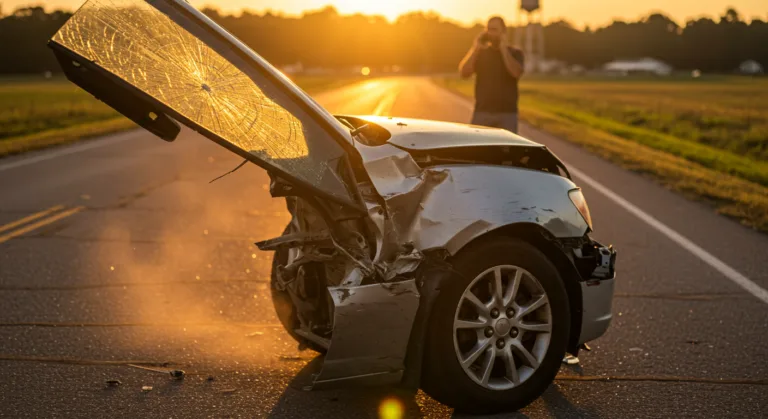
Michael was just running his normal Grubhub route in Phoenix. It was a Tuesday morning in early 2026, and he was working the streets of the Biltmore area like he always did. He was heading south on 24th Street with an order for a high-rise office building, a routine drop-off, when some distracted driver shot into his lane near Camelback Road. The impact was violent, throwing his sedan into the median. The immediate injuries were one thing, but the real complication was an old lumbar disc problem, a pre-existing condition that roared back to life with blinding pain right after the crash. So, can a pre-existing condition really sink a Grubhub Phoenix accident claim?
Key Takeaways
- You absolutely have to get all your medical records documenting your pre-existing condition, both from before and after the wreck. This is non-negotiable for a personal injury claim.
- Arizona’s “eggshell skull” rule is on your side. It says the at-fault party has to take you as you are, meaning they’re liable even if your pre-existing condition made the injury much worse.
- Grubhub drivers in Phoenix are independent contractors, so workers’ comp isn’t an option. That makes your personal injury claim against the other driver’s insurance the only game in town.
- Talking to a lawyer right after the accident, especially when an old injury is involved, can completely change the outcome of your case.
- Insurance companies will always try to blame your pain on your pre-existing condition to pay you less. This is why you need a good lawyer who knows their playbook.
The Immediate Aftermath: Pain and Paperwork
After the initial shock wore off, a searing pain shot through Michael’s lower back. He hadn’t felt anything that bad since a minor incident at an old job five years ago. Paramedics from Phoenix Fire Department Station 8 got to the scene, checked him for trauma, and made a note of his back pain complaints. They took him over to Banner – University Medical Center Phoenix. An X-ray and MRI there confirmed it: a herniated disc at L4-L5, the exact spot as his old injury. The ER doc’s discharge summary spelled it out clearly: exacerbation of a pre-existing spinal issue.
For any Grubhub driver, the fallout from a wreck brings its own unique headaches. Michael wasn’t an employee, he was an independent contractor. That classification means no workers’ comp coverage from Grubhub. To get his medical bills, lost income, and pain and suffering covered, his only shot was filing a personal injury claim against the other driver’s insurance. This detail is everything for gig workers in Arizona, because the Arizona Corporation Commission doesn’t classify drivers like him as employees who would get workers’ comp. So when Michael made that first call to the at-fault driver’s insurer, he was already starting from behind.
“On July 30, 2025, Mary Jane Jung went into cardiac arrest in the middle of the New York bar exam. According to her complaint, she lost consciousness and turned blue in front of proctors, staff, and more than 600 other examinees.”
Working through the Insurance Maze: The Pre-Existing Condition Defense
A few days later, Michael called the at-fault driver’s insurance company, one of the big national carriers. He laid out the facts of the crash and sent over his initial medical reports. The adjuster was polite, but she went straight for the jugular, zeroing in on the mention of his prior back problems. “Mr. Rodriguez,” she said, “we see this is difficult, but it looks like your current back pain is from a pre-existing condition. Our client is only responsible for injuries caused by this specific accident, not for issues you already had.”
This is the oldest trick in the book. Insurance companies will try to deny or lowball claims by arguing the person’s pain isn’t new, it’s just the same old injury flaring up. They dig through your medical history looking for anything that lets them cast doubt on where the current injury came from. For Michael, who’d had some mild, manageable back pain on and off for years, this was a huge problem. He had old physical therapy records from 2021 and notes from a few chiropractor visits, and the insurance company wanted to see every last page.
But here’s the thing: Arizona law has a defense for this, called the “eggshell skull” rule (or the “thin skull” rule). It’s a legal principle that says a defendant has to take their victim as they find them. If someone’s negligence hurts you, they’re responsible for all the harm that follows, even if your pre-existing condition made you more likely to get seriously injured than an ordinary person. The Arizona Court of Appeals has confirmed this in cases like Siverson v. Martori. The defendant can’t get out of paying by claiming a “normal” person wouldn’t have been hurt so badly. You just have to prove the accident aggravated the old condition, causing new pain and making it harder for you to function.
The Legal Strategy: Proving Exacerbation
Michael knew he was in over his head, so he got a lawyer. His attorney saw the play coming a mile away. “The insurance company’s going to argue the crash didn’t cause a new injury, it just brought back some old pain,” the lawyer told him during their first meeting near the Maricopa County Superior Court. “Our job is to prove this collision made your condition way worse, giving you symptoms and pain you never had before.”
The strategy they built had a few key parts:
- Detailed Medical Documentation: The lawyer immediately started collecting Michael’s complete medical files from his doctors, including his orthopedic surgeon at OrthoArizona. This meant getting imaging reports like MRIs and X-rays, all the physician’s notes, physical therapy records, and pain management charts from before *and* after the crash. The idea was to show what his back looked like before the accident, and then show just how much worse it got after.
- Expert Medical Testimony: In a case with a complex pre-existing injury, you often need an expert to connect the dots for the insurance company (or a jury). A neurosurgeon or an orthopedic specialist can give a professional opinion, to a reasonable degree of medical certainty, that the force of this specific collision is what caused the old injury to get so much worse.
- Comparative Evidence: Michael’s attorney also gathered proof of what his life was like before the accident. This included statements from his family and friends, his Grubhub earnings which showed he was working full-time without any major gaps for pain, and even some data from his fitness tracker. It all helped paint a picture of a guy who, yes, had an old back issue, but it was basically quiet and didn’t stop him from working or living his life.
- Demand Letter and Negotiation: With all the evidence in hand, the lawyer drafted a complete demand letter. It broke down the crash, Michael’s injuries, his medical bills, his lost wages, and laid out the legal argument for why the other driver was 100% responsible, citing Arizona’s eggshell skull rule precedent.
The real smoking gun was a side-by-side comparison of Michael’s MRIs. A scan from 2023 showed a stable disc bulge at L4-L5. But the new MRI, taken right after the accident at SimonMed Imaging on Tatum Boulevard, showed a much bigger herniation at that same spot, with clear nerve root compression. The insurance company couldn’t really argue with that kind of objective proof.
The Settlement: Acknowledging the Aggravation
Negotiations dragged on. The insurance company’s first offer was a joke, just them repeating their argument that Michael’s “old injury” was the real problem. But his lawyer held his ground, laying out the medical evidence and pointing back to Arizona law. The threat of actually filing the lawsuit in Maricopa County Superior Court started to feel very real to the insurer.
Finally, after a few more rounds and a virtual mediation session, the company caved and came back with a much higher offer. They saw the strength of the medical evidence showing his condition was aggravated and knew the legal risk of taking an “eggshell skull” case to trial. Michael accepted a settlement that paid for his medical treatment (past and future), covered the income he lost from being unable to drive for Grubhub, and gave him fair compensation for his pain and suffering. That money meant he could get the physical therapy he needed and manage his now-chronic condition without being buried in medical debt.
Lessons Learned for Grubhub Drivers in Phoenix
Michael’s whole ordeal offers some clear takeaways for any Grubhub driver in Phoenix who gets into a wreck, especially if you have a pre-existing condition:
- Seek Immediate Medical Attention: Go get checked out by a doctor or at an ER right after an accident, even if you think you’re okay. Getting your injuries documented from day one is a big deal.
- Disclose Medical History: Don’t hide your pre-existing conditions from your doctors. Be upfront. They need to know your history to accurately diagnose how the accident affected you and put it in their notes.
- Document Everything: Keep a file with every medical appointment, bill, prescription, and treatment record. Also, track the hours you can’t work and the money you’re losing.
- Understand Your Independent Contractor Status: Remember, as a gig worker, you probably don’t have workers’ comp. That means a personal injury claim against the at-fault driver is your main path to getting compensation.
- Consult a Personal Injury Attorney: Trying to fight an insurance company on your own is a bad idea, especially with a pre-existing condition in the mix. A good lawyer knows their tactics, knows how to build a case with evidence, and can fight for a fair settlement.
Having a pre-existing condition doesn’t mean you can’t get paid after an accident. It makes the claim harder, no doubt, but Arizona law is set up to protect people whose conditions are made worse by someone else’s carelessness. It all comes down to having solid documentation, the right medical opinions, and a lawyer who knows how to prove the accident’s direct impact on your health.
For a Grubhub driver working through Phoenix traffic, knowing how these claims work isn’t just an academic exercise. It can be the one thing that stands between you and financial disaster. Don’t just assume you don’t have a case. Focus on getting your proof together and find a professional who can protect your rights.
What is the “eggshell skull” rule in Arizona?
In Arizona, the “eggshell skull” rule (or “thin skull” rule) says that an at-fault person is responsible for all the harm they cause, even if the victim had a pre-existing condition that made them more fragile or caused their injuries to be worse than average. They can’t use your prior health as an excuse to pay less.
How do I prove an accident aggravated my pre-existing condition?
You need hard medical evidence. The best way is to compare medical records and imaging tests (like MRIs) from before the accident to new ones taken after, showing a clear decline. Testimony from your doctors explaining how the crash worsened your old injury is powerful. You should also document how your pain and physical abilities have changed for the worse since the wreck.
Can I get workers’ compensation as a Grubhub driver in Phoenix if I have a pre-existing condition?
Almost certainly not. In Arizona, Grubhub drivers are considered independent contractors, not employees. That status makes you ineligible for workers’ compensation benefits through Grubhub. Your path for compensation is a personal injury claim against the driver who caused the accident.
What kind of documentation do I need if I have a pre-existing condition and am in an accident?
Gather every medical record you can find related to your pre-existing condition from before the crash, doctor’s notes, MRI/X-ray reports, physical therapy charts, prescriptions. Then, after the accident, keep careful records of all your new appointments, treatments, and diagnoses. Also, save pay stubs to show lost income and receipts for any other expenses.
Will my pre-existing condition automatically reduce my settlement amount?
It shouldn’t, if you have a good case. Insurance adjusters will definitely try to use it to lowball you, but that’s where the “eggshell skull” rule comes in. If you can prove the accident made your condition flare up or actively made it worse, you are entitled to be compensated for that new level of pain and limitation. It’s about proving the *change* caused by the accident.