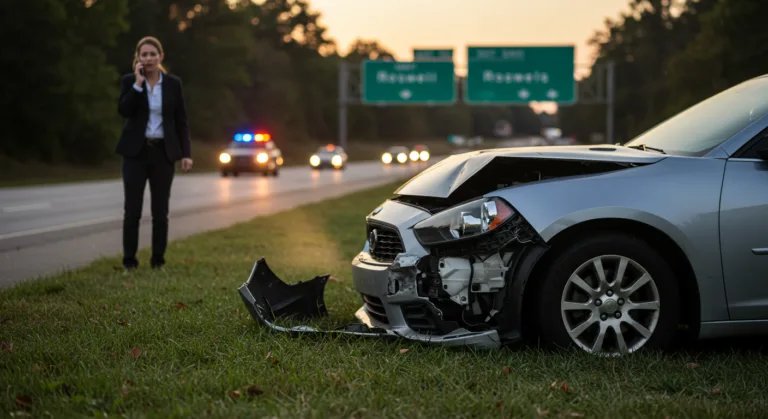
When an Uber driver gets T-boned in Athens, it’s about a lot more than just a wrecked car and a trip to the ER. It’s the start of a huge legal fight over gig worker rights. These wrecks, especially at intersections we all know like Prince Avenue and Milledge Avenue, show just how vulnerable rideshare drivers really are, stuck in a legal no-man’s-land between independent contractor and employee. To get fair compensation, you have to know the specific challenges and what strategies actually work in these cases.
Key Takeaways
- What Uber’s insurance covers depends entirely on your status in the app when the wreck happens: offline, waiting for a ride, or on a trip.
- Georgia’s law for transportation network companies, O.C.G.A. Section 33-1-24, dictates their insurance requirements and complicates the claims process.
- You have to document everything at the scene. Photos, witness info, and getting that police report are the foundation of a good claim.
- If you’re an injured gig worker, get to a doctor right away and keep a perfect record of every single treatment, bill, and related expense.
- To negotiate with insurance companies, you have to have a rock-solid grasp of policy limits, Georgia’s comparative negligence rules, and how to calculate future medical costs.
Case Study 1: The Morning Commute Catastrophe
Take the case of Mr. David Chen, a 38-year-old part-time Uber driver who was also a full-time software developer in Athens-Clarke County. On a Tuesday morning in April 2025, he was waiting to pick up a passenger near the UGA campus on Lumpkin Street when a distracted driver blew a red light and T-boned his Honda Civic. The impact was violent, leaving Mr. Chen with a fractured tibia, whiplash, and a concussion that sent him straight to Piedmont Athens Regional Medical Center.
Circumstances and Immediate Challenges
The student who hit him, just 22 years old, only had the state minimum liability coverage: $25,000 for bodily injury, as required by O.C.G.A. Section 33-7-11. Mr. Chen’s medical bills blew past that number almost immediately. The real fight was pinning down Uber’s liability. Because he had already accepted a ride and was on his way to the passenger, he was in what Uber calls “Period 2.” This meant Uber’s $50,000 contingent liability policy was supposed to kick in, but getting them to pay required a mountain of paperwork and tough negotiations with their claims department.
Legal Strategy and Outcome
We had to attack on two fronts. First, we went after the at-fault driver’s policy for the full amount. Second, we pursued a claim against Uber’s policy. We collected every medical record, including detailed reports from his orthopedist and neurologist that projected his need for long-term physical therapy, and we also got our hands on traffic camera footage that left no doubt about who was at fault. The negotiation with Uber’s insurance company, one of the big national carriers, was a slog. They tried the classic move of arguing that Mr. Chen’s pre-existing neck stiffness was the real cause of his whiplash. We shut that down with expert medical testimony that directly linked his specific injuries to the T-bone impact.
After nearly eight months of fighting, which included sending a formal demand letter outlining all his economic and non-economic damages, we settled Mr. Chen’s case for a total of $125,000. This was made up of the full $25,000 from the student’s policy and $100,000 from Uber’s coverage, which paid for his medical care, his lost income from his main software job, and his pain and suffering. Mr. Chen was frustrated by how long it took, but eight months is pretty typical when you’re dealing with a serious injury and have to fight multiple insurance companies.
Case Study 2: The Uninsured Motorist Nightmare
Ms. Elena Rodriguez, a 55-year-old grandmother who drove for Uber part-time in Athens, had a terrifying experience one evening in September 2024. She was driving a passenger down Broad Street when a car tried an illegal U-turn and T-boned her Toyota Camry. The other driver took off, leaving Ms. Rodriguez with a broken arm, fractured ribs, and intense emotional trauma. Her passenger had minor injuries as well.
Circumstances and Immediate Challenges
The biggest problem was a ghost driver, with no one to identify, there was no third-party insurance company to sue. Ms. Rodriguez was on an active trip, so Uber’s massive $1 million uninsured/underinsured motorist (UM/UIM) policy should have been triggered. Getting that money is never easy, though. Uber’s insurer demands absolute proof that the other driver was either uninsured or that you made a serious effort to find them and couldn’t. To make matters worse, Ms. Rodriguez’s own personal car insurance had only minimum UM coverage, which wouldn’t have come close to covering her bills.
Legal Strategy and Outcome
We worked directly with the Athens-Clarke County Police Department to push the hit-and-run investigation. The driver was never found, but we documented every single step the police took, collecting witness statements and pulling surveillance video from nearby shops. All this evidence was key to proving to Uber’s insurer that this was a legitimate “uninsured” claim. We also made sure Ms. Rodriguez got all the care she needed, from orthopedic surgery on her arm to counseling for her post-traumatic stress. The bills and records for these treatments, especially from her physical therapy at Athens Orthopedic Clinic, became the core of our demand package.
The fight with Uber’s UM carrier was brutal. They tried to downplay her emotional distress and even suggested her age was the reason her physical recovery was taking so long. We countered with expert testimony from her therapist and her surgeon to destroy those arguments. After almost a year of back-and-forth, the case went to mediation, which is common in these complex claims. In mediation, we laid out the full extent of her damages, including the need for future medical care for her arm and ongoing therapy. Ms. Rodriguez walked away with a $380,000 settlement. The amount was so high because her injuries were severe, the emotional impact was undeniable, and with no at-fault driver to sue, Uber’s UM policy was her only shot at recovery.
Case Study 3: The “Off-Duty” Dilemma
Mr. Thomas Green, a 28-year-old recent grad driving Uber to make ends meet in Athens, got into a bad T-bone wreck at Baxter Street and Alps Road in February 2025. He had just dropped off his last passenger and was heading home. His Uber app was still open, but he wasn’t actively looking for rides, he was “offline” but hadn’t fully logged out yet. A driver distracted by their phone ran a stop sign and smashed into his Ford Focus, causing a herniated disc in his lower back.
Circumstances and Immediate Challenges
This case created a huge headache over Uber’s coverage. Since Mr. Green was technically “offline,” Uber’s insurance usually provides zero coverage. The fact that the crash happened just moments after a drop-off made things murky. The at-fault driver had decent insurance, but Mr. Green’s back injury was serious, needing spinal injections and possibly surgery down the road, which meant his damages were going to be far higher than the other driver’s policy limits.
Legal Strategy and Outcome
Our plan was to get every penny from the at-fault driver’s policy and then pivot to Mr. Green’s own uninsured/underinsured motorist (UM) coverage. We still put Uber on formal notice about the accident, you never want to leave any stone unturned, even though it was a long shot that their policy would apply since he wasn’t in Period 1, 2, or 3. The main battle was with the at-fault driver’s insurer. They immediately claimed his back injury was pre-existing from his active lifestyle. We hit back with MRI reports and testimony from his spine specialist at Athens Spine Center that proved the herniation was a direct result of the crash.
The at-fault driver’s policy limit was $100,000, and since liability was crystal clear, we secured that money pretty quickly. The next fight was with Mr. Green’s own insurance company over his UM policy, which had a $250,000 limit. You’d think your own insurer would be on your side, but they fought hard to pay out as little as possible. We didn’t waste time. We filed a lawsuit in Clarke County Superior Court. That action showed we were ready for trial and usually gets insurers to rethink their lowball offers. Right before the discovery phase was over, the case settled for a total of $220,000. The final amount came from two sources: the $100,000 from the at-fault driver and an extra $120,000 from Mr. Green’s UM policy, giving him the funds for his medical care and compensating him for his considerable pain.
Understanding Settlement Ranges and Factor Analysis
These cases show how much the outcomes can vary, from $125,000 up to $380,000. A handful of factors really determine what a case is worth:
- Severity of Injuries: This is the single biggest factor. A catastrophic injury like spinal cord damage, a traumatic brain injury, or severe fractures requiring surgery will always result in a higher settlement because the medical costs, need for future care, and impact on the person’s life are so immense.
- Medical Expenses: It’s all about the paper trail. We’re talking about documented past bills and solid projections for future surgeries, physical therapy, and medications. This forms the base of the economic damages.
- Lost Wages and Earning Capacity: You get paid for the money you lost while recovering and for any permanent disability that reduces your ability to earn in the future. Proving lost income is harder for gig workers. You have to carefully document your earnings using reports from the Uber app and your tax filings.
- Pain and Suffering: This is compensation for the human cost, the physical pain, the emotional distress, and the loss of enjoyment of life. While it’s subjective, it’s typically calculated by multiplying the hard economic damages (the medical bills and lost wages).
- Liability and Fault: A case is much stronger when the other driver is clearly 100% at fault. Under Georgia’s modified comparative negligence law (O.C.G.A. Section 51-12-33), if you are found 50% or more to blame for the crash, you get nothing.
- Insurance Policy Limits: This is the ceiling on your recovery. The hard truth is that a catastrophic injury case can end up with a small settlement if there just isn’t enough insurance money to collect from the at-fault driver, Uber, or your own policy.
- Legal Representation: You can’t just walk into this blind. An experienced lawyer knows how to pick apart the complex insurance policies, argue effectively with adjusters, and take the case to court if the company won’t pay a fair amount. Insurance companies have armies of lawyers, and you need someone in your corner.
Handling the fallout from an Uber driver accident in Athens, particularly a T-bone crash, means you’ve got to understand both personal injury law and the tangled mess of policies that govern these rideshare companies. Every detail matters. The severity of the injury and the driver’s exact status on the app will completely change the legal strategy and what a case is worth. Getting a lawyer who knows these cases right away can be the difference between getting paid what you’re owed and walking away with nothing.
What are the different periods of Uber insurance coverage?
Uber’s insurance has three phases that matter. Period 1 is when your app is on but you’re waiting for a ride request. Period 2 starts the moment you accept a request and are driving to pick the person up. Period 3 is when the passenger is actually in your car. The money available changes drastically between these periods. Periods 2 and 3 have the big liability and uninsured motorist policies, while Period 1 offers much lower contingent coverage.
What should an Uber driver do immediately after an accident in Georgia?
First thing: check if anyone is hurt and call 911 for police and an ambulance. Then, you have to exchange insurance and contact information with the other driver. After that, your job is to be a detective: take photos and videos of everything, the car damage, skid marks, road conditions, and any injuries you can see. Go to the doctor right away, and report the crash to Uber through their app.
Can I claim lost wages if I’m an Uber driver injured in an accident?
Yes, you can absolutely make a claim for lost wages. To do it, you’ll need to pull your detailed earnings history from the Uber app, find your recent tax returns, and get a disability note from your doctor that clearly states you’re unable to work because of your injuries. It’s tougher to prove lost income as a gig worker, so you need a very clear paper trail.
How does Georgia’s comparative negligence law affect my claim?
Georgia’s law is harsh. It’s called “modified comparative negligence,” which means if you are found to be 50% or more at fault for the accident, you are legally barred from recovering a single penny. Any fault assigned to you that’s less than 50% reduces your recovery by that same percentage. For example, if a jury says you were 20% at fault, your final award gets cut by 20%.
Is it necessary to hire a lawyer for an Uber accident claim?
You’re not legally required to hire a lawyer, but for a serious Uber accident, you’d be crazy not to. You’re dealing with confusing insurance policies, multiple potential defendants, and huge insurance companies that will use aggressive tactics to pay as little as possible. A good lawyer handles that maze, fights for a real settlement, and isn’t afraid to sue if necessary, which dramatically improves your chances of getting what you deserve.