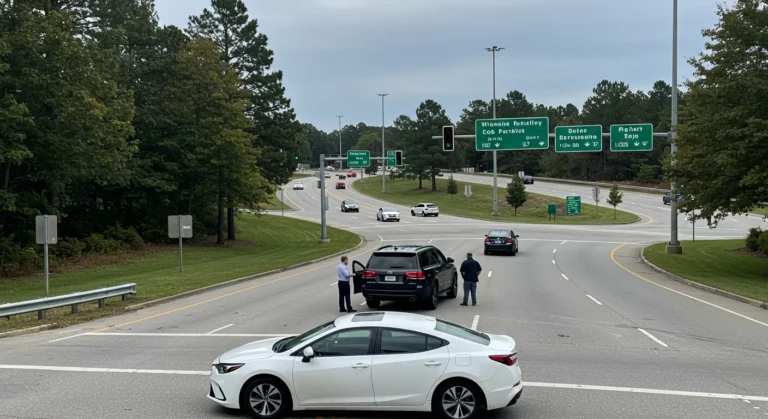
Navigating the aftermath of a car accident in Georgia, especially in bustling areas like Sandy Springs, can feel like driving through a dense fog of misinformation. Are you really prepared for what happens after a wreck, or are you relying on outdated myths that could cost you dearly?
Key Takeaways
- In Georgia, you generally have two years from the date of the car accident to file a personal injury lawsuit, according to O.C.G.A. § 9-3-33.
- Georgia is an “at-fault” state, meaning the driver responsible for the car accident is liable for damages, and you may need to prove negligence to recover compensation.
- Even if you are partially at fault for a car accident in Georgia, you may still be able to recover damages if you are less than 50% responsible.
## Myth #1: Georgia is a “No-Fault” State
A common misconception I hear from clients, especially those new to Georgia from states like Florida or Michigan, is that Georgia operates under a “no-fault” car insurance system. This simply isn’t true. Georgia is an “at-fault” state. This means that after a car accident in Georgia, the person responsible for causing the accident is also responsible for paying for the damages.
This is a critical distinction. In a no-fault state, your own insurance typically covers your medical bills and lost wages, regardless of who caused the accident. In Georgia, you must prove that another driver was negligent to recover compensation from their insurance company. This negligence could involve speeding, distracted driving, drunk driving, or any other violation of traffic laws. The importance of gathering evidence – police reports, witness statements, photos of the scene – cannot be overstated. I once had a client in Sandy Springs who assumed his insurance would automatically cover his medical bills after a rear-end collision on Roswell Road. It wasn’t until we investigated and proved the other driver was texting that we could successfully pursue a claim against the at-fault driver’s insurance.
## Myth #2: If I’m Partially at Fault, I Can’t Recover Anything
This is another harmful myth. Georgia follows a modified comparative negligence rule. Under O.C.G.A. § 51-12-33, you can recover damages even if you were partially at fault for the accident, as long as your percentage of fault is less than 50%.
However, your recovery will be reduced by your percentage of fault. For example, if you sustained $10,000 in damages but were found to be 20% at fault, you could only recover $8,000. This is why determining fault is so crucial. Insurance companies will often try to assign you a higher percentage of fault to reduce their payout. In a recent case we handled involving a collision near the intersection of Abernathy Road and GA-400, the insurance company initially claimed our client was 60% at fault. We were able to present evidence showing the other driver ran a red light, reducing our client’s fault to 10% and significantly increasing her compensation. Don’t assume the insurance company’s initial assessment is accurate.
## Myth #3: I Have Plenty of Time to File a Lawsuit
Procrastination can be a costly mistake. While it’s true that Georgia has a statute of limitations for personal injury cases, including car accident claims, you don’t have unlimited time. Generally, you have two years from the date of the accident to file a lawsuit, as specified in O.C.G.A. § 9-3-33.
Missing this deadline means you lose your right to sue for damages. Two years may seem like a long time, but it passes quickly. Gathering evidence, negotiating with insurance companies, and preparing a case can take considerable time. I’ve seen too many people lose out because they waited too long. There are some exceptions that might extend the deadline – for example, if a minor is injured. But don’t rely on exceptions; start the process as soon as possible. For more information, see this article on making costly car accident mistakes.
Here’s what nobody tells you: the insurance company is not on your side. They’re looking out for their bottom line. Delaying a claim only benefits them.
## Myth #4: The Police Report Determines Fault
While a police report is a valuable piece of evidence, it is not the final word on who was at fault for the car accident. Police officers are trained to investigate accidents and provide their opinion on what happened, but their opinion is not binding on a court or an insurance company.
The officer’s assessment of fault is often based on their interpretation of the scene, witness statements, and traffic laws. However, insurance companies and courts can conduct their own investigations and reach different conclusions. We recently handled a case in Sandy Springs where the police report initially placed fault on our client. However, we obtained video footage from a nearby business that clearly showed the other driver speeding and running a stop sign. This evidence allowed us to overturn the initial fault determination and secure a favorable settlement for our client. The key is to gather as much independent evidence as possible to support your claim, regardless of what the police report says. You can’t always trust it, as discussed in this post about Georgia car accident fault.
## Myth #5: I Can Handle My Car Accident Claim Alone
While it may seem tempting to handle your car accident claim yourself, especially for minor accidents, doing so can be a risky proposition. Insurance companies are skilled at minimizing payouts, and they may take advantage of unrepresented individuals.
An experienced Georgia car accident lawyer can help you navigate the complex legal process, gather evidence, negotiate with the insurance company, and, if necessary, file a lawsuit. We understand the nuances of Georgia law and know how to build a strong case on your behalf. Plus, studies consistently show that people who hire attorneys often receive significantly higher settlements than those who represent themselves. I remember a case where a client initially accepted a $5,000 settlement offer from the insurance company after a collision on Johnson Ferry Road. After consulting with us, we were able to uncover additional damages and negotiate a settlement of $50,000. The insurance company had clearly lowballed her because she didn’t understand the full extent of her rights and damages.
Don’t underestimate the value of professional legal representation. It’s an investment that can pay off significantly in the long run. If you’ve had a Sandy Springs car wreck, it’s especially vital to protect your claim.
The information surrounding Georgia car accident laws is often confusing and misleading. Don’t let myths and misconceptions dictate your actions after a wreck. If you’ve been injured in a car accident in Sandy Springs or anywhere in Georgia, it’s essential to seek legal guidance from a qualified attorney to protect your rights and ensure you receive the compensation you deserve.
How long do I have to file a car accident claim in Georgia?
Generally, you have two years from the date of the accident to file a personal injury lawsuit in Georgia, according to O.C.G.A. § 9-3-33.
What if the other driver doesn’t have insurance?
If the other driver is uninsured, you may be able to recover damages through your own uninsured motorist (UM) coverage. It is very important to have UM coverage.
What damages can I recover in a car accident claim?
You may be able to recover damages for medical expenses, lost wages, property damage, pain and suffering, and other related losses.
What should I do immediately after a car accident?
First, ensure your safety and the safety of others involved. Call the police to report the accident. Exchange information with the other driver. Take photos of the scene and any damage to the vehicles. Seek medical attention if you are injured, and contact an attorney as soon as possible.
How much does it cost to hire a car accident lawyer?
Most car accident lawyers work on a contingency fee basis, meaning you only pay a fee if they recover compensation for you. The fee is typically a percentage of the settlement or court award.
Don’t let insurance companies dictate the terms of your settlement. Consult with a qualified attorney to understand your rights and explore your options. It’s the single best step you can take to protect yourself after a car accident.