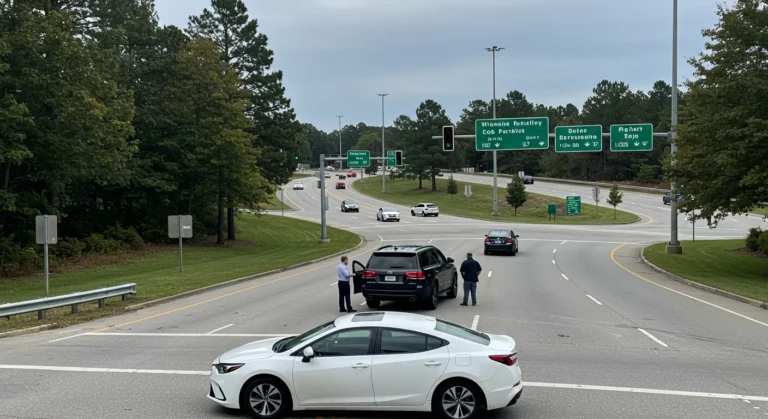
Experiencing a car accident in Dunwoody, Georgia, can be a profoundly disorienting and stressful event, often leaving individuals unsure of their next steps and rights. Recent legislative adjustments, particularly surrounding evidentiary standards in personal injury claims, underscore the critical need for immediate, informed action following any vehicular collision. Are you truly prepared for the legal aftermath?
Key Takeaways
- Immediately after an accident, exchange information, document the scene thoroughly with photos and video, and seek prompt medical attention, even for seemingly minor injuries.
- Report the accident to the Dunwoody Police Department or Georgia State Patrol and your insurance company without delay, but avoid making recorded statements or admitting fault.
- Understand Georgia’s modified comparative negligence rule (O.C.G.A. § 51-12-33), which can reduce or bar recovery if you are found 50% or more at fault.
- Be aware of the new evidentiary thresholds under the Georgia Civil Practice Act (O.C.G.A. § 9-11-104), impacting how medical expenses and causation are proven in court.
- Consult with an experienced personal injury attorney in Dunwoody as soon as possible to protect your rights and navigate complex legal procedures.
Understanding Recent Legal Shifts Affecting Car Accident Claims in Georgia
The legal landscape for personal injury claims in Georgia is always evolving, and 2026 has brought some significant clarifications that directly impact how car accident cases are litigated. Specifically, I’m referring to the recent judicial interpretations and legislative refinements to the Georgia Civil Practice Act, particularly concerning the admissibility of evidence related to medical expenses and causation. While not a wholesale overhaul, these changes, solidified by recent rulings from the Georgia Court of Appeals, emphasize the importance of meticulous documentation and expert testimony. They effectively raise the bar for plaintiffs attempting to prove the necessity and reasonableness of their medical treatment.
What does this mean for you after a car accident on Perimeter Center Parkway or Ashford Dunwoody Road? It means that simply presenting a stack of medical bills won’t cut it anymore. The courts are increasingly demanding stronger, more direct links between the accident, the injuries sustained, and the specific treatments rendered. This isn’t just about bills; it’s about the narrative of your recovery, backed by qualified medical professionals. This shift isn’t about making it harder to recover deserved compensation, but rather ensuring that claims are robustly supported by evidence that stands up to rigorous scrutiny. The effective date for these clearer evidentiary standards has been phased in over the last year, but their full impact is truly being felt now as cases from 2025 and early 2026 begin to move through the Fulton County Superior Court system.
Immediate Steps to Take at the Accident Scene in Dunwoody
The moments immediately following a car accident are chaotic, but what you do—or don’t do—can profoundly affect any future claim. Your safety and the safety of others must be your priority. First, if possible and safe, move your vehicle to the side of the road, out of traffic. This is particularly important on busy thoroughfares like I-285 or State Route 400, where secondary collisions are a real danger.
Next, check for injuries. Even if you feel fine, adrenaline can mask pain. Seek medical attention immediately if anyone is hurt. Call 911 to report the accident. The Dunwoody Police Department will respond to document the scene. When the police arrive, cooperate fully, but avoid admitting fault or making speculative statements. Stick to the facts: where you were going, what you saw, what happened. Obtain the police report number and the responding officer’s name. This report, though not always admissible as evidence of fault in court, is a critical record of the incident.
I always tell my clients: documentation, documentation, documentation. Use your smartphone to take extensive photos and videos of everything. Capture damage to all vehicles involved, skid marks, road conditions, traffic signs, debris, and the surrounding environment. Get close-ups and wide shots. If there are any visible injuries, photograph them. Exchange information with all other drivers involved: name, contact information, insurance company and policy number, and vehicle make, model, and license plate number. Do not, under any circumstances, engage in arguments or confrontational behavior.
Witnesses are invaluable. If anyone stopped, get their names and contact information. Their unbiased account can be crucial later on. I had a client last year, involved in a fender bender near the Dunwoody Village Shopping Center. He thought it was minor, didn’t get witness info. Later, the other driver tried to inflate their injuries. Without a third-party account, we had a much harder time refuting their exaggerated claims. Don’t make that mistake.
Reporting the Accident and Dealing with Insurance Companies
After ensuring safety and documenting the scene, your next critical step is to report the accident to your own insurance company. Do this as soon as possible, ideally within 24 hours. Most policies require prompt notification. However, and this is an editorial aside I feel strongly about, be extremely cautious about what you say. You are obligated to report the accident, but you are not obligated to give a recorded statement without legal counsel present. Your insurance company, and especially the other driver’s insurance company, will try to get you to say things that can be used against you. They are not on your side; they are protecting their bottom line.
When speaking with insurers, provide only factual information: the date, time, and location of the accident, and the names of the parties involved. Do not discuss fault, injuries, or specific damages in detail. Do not sign anything without having your attorney review it first. This includes medical authorizations or settlement offers. Remember, an initial offer is almost always a lowball. They want to make the problem away for as little as possible. It’s a common tactic, and frankly, it’s infuriating to see clients accept far less than they deserve because they felt pressured.
Under O.C.G.A. § 33-7-11, Georgia requires all drivers to carry minimum liability insurance. However, many drivers carry only the minimum, which might not be enough to cover serious injuries or extensive property damage. This is why having uninsured/underinsured motorist (UM/UIM) coverage on your own policy is so vital. If the at-fault driver has insufficient insurance, your UM/UIM coverage can kick in to protect you. We recently handled a case where a client was hit by an uninsured driver near the Perimeter Mall exit. Without his substantial UM coverage, his extensive medical bills from Northside Hospital Atlanta would have been a catastrophic personal burden. Always review your policy limits and consider increasing them.
Seeking Medical Attention and Documenting Injuries
This is non-negotiable: seek medical attention immediately after a car accident, even if you feel fine. Many serious injuries, such as whiplash, concussions, or internal bleeding, may not present symptoms for hours or even days. Delaying treatment not only jeopardizes your health but can also significantly weaken your personal injury claim. Insurance companies love to argue that if you waited to see a doctor, your injuries must not have been caused by the accident. Don’t give them that ammunition.
Visit an emergency room, an urgent care center, or your primary care physician. Be thorough and honest with your medical providers about all pain, discomfort, and symptoms, no matter how minor they seem. Follow all treatment recommendations diligently, attend all follow-up appointments, and complete any prescribed physical therapy or rehabilitation. Every medical record, every bill, and every prescription becomes part of the evidence supporting your claim. Keep a detailed journal of your symptoms, pain levels, limitations, and how the injuries impact your daily life. This personal account can be incredibly powerful in conveying the true extent of your suffering.
Case Study: The Roswell Road Rear-End
Consider the case of Ms. Emily R., who was rear-ended on Roswell Road near the Dunwoody/Sandy Springs border in late 2025. Initially, she felt only minor neck stiffness. She went home, thinking she’d just “sleep it off.” The next morning, her neck pain was excruciating, radiating down her arm, and she had a persistent headache. She finally went to Emory Saint Joseph’s Hospital’s emergency room. Diagnostic imaging revealed a herniated disc. Because of her delay, the at-fault driver’s insurance company immediately tried to argue that her disc injury wasn’t caused by the accident but was a pre-existing condition or occurred later. We had to work tirelessly with her neurosurgeon, providing detailed medical records, expert testimony, and even a biomechanical engineer’s report to definitively link the injury to the collision. It took an additional six months and significantly more legal resources to overcome the insurer’s initial denial. Had she gone to the ER immediately, the causal link would have been far clearer, streamlining her path to a fair settlement of over $150,000 for medical bills, lost wages, and pain and suffering.
Understanding Georgia’s Comparative Negligence Rule
Georgia operates under a modified comparative negligence rule, codified in O.C.G.A. § 51-12-33. This statute is absolutely critical for anyone involved in a car accident. It states that you can only recover damages if you are found to be less than 50% at fault for the accident. If you are 50% or more at fault, you cannot recover anything. Furthermore, if you are found to be partially at fault (e.g., 20% at fault), your recoverable damages will be reduced by your percentage of fault. So, if your total damages are $100,000 but you are deemed 20% responsible, you can only recover $80,000.
This is where the police report, witness statements, and your own documentation become incredibly important. Insurance companies will always try to assign some percentage of fault to you to reduce their payout. For instance, if you were hit by a drunk driver but you were found to be slightly speeding on Chamblee Dunwoody Road, the insurer might try to argue your speeding contributed to the severity of the accident. We vigorously defend our clients against such attempts, using accident reconstructionists and expert witnesses when necessary to establish the true chain of events and fault.
When to Consult a Dunwoody Car Accident Attorney
My advice is always the same: if you’ve been involved in a car accident in Dunwoody that resulted in any injury, even seemingly minor ones, consult with an experienced personal injury attorney as soon as possible. The sooner you involve legal counsel, the better protected your rights will be. We can immediately take over communication with insurance companies, ensuring you don’t inadvertently say something that harms your claim. We can help you navigate the complexities of obtaining medical care, securing necessary evidence, and understanding the nuances of Georgia law, including the recent evidentiary shifts I mentioned earlier.
A good attorney will also help you understand the full value of your claim, not just your immediate medical bills. This includes lost wages, future medical expenses, pain and suffering, and other non-economic damages. Many people underestimate these components. We provide guidance on navigating the Dunwoody municipal court system for traffic citations that may arise from the accident, ensuring those don’t negatively impact your civil claim. Frankly, trying to handle a serious injury claim on your own against a team of insurance adjusters and lawyers is like trying to perform surgery on yourself – it rarely ends well. We know the system, we know the tactics, and we know how to fight for what you deserve. Don’t go it alone.
Navigating the aftermath of a car accident in Dunwoody requires immediate, informed action and a clear understanding of your legal rights and responsibilities.
What is the statute of limitations for car accident claims in Georgia?
In Georgia, the general statute of limitations for personal injury claims, including those arising from car accidents, is two years from the date of the accident, as outlined in O.C.G.A. § 9-3-33. For property damage, it’s typically four years. Missing these deadlines means you likely lose your right to sue.
Should I accept the first settlement offer from the insurance company?
Absolutely not. The first offer from an insurance company is almost always a lowball attempt to settle your claim quickly and for the least amount possible. They often don’t account for future medical expenses, lost wages, or the full extent of your pain and suffering. Always consult with an attorney before accepting any settlement offer.
What if the other driver doesn’t have insurance?
If the at-fault driver is uninsured or underinsured, your best recourse is often your own uninsured/underinsured motorist (UM/UIM) coverage. This coverage is designed to protect you in such situations. If you don’t have UM/UIM coverage, your options may be limited, but an attorney can still explore possibilities like suing the at-fault driver directly.
How long does a car accident claim take to resolve in Georgia?
The timeline for resolving a car accident claim varies widely depending on the complexity of the case, the severity of injuries, the willingness of insurance companies to negotiate, and whether a lawsuit becomes necessary. Simple claims might settle in a few months, while complex cases involving significant injuries or disputes over fault can take a year or more, especially if they proceed to litigation in the Fulton County Superior Court.
What types of damages can I recover after a car accident?
You can typically recover both economic and non-economic damages. Economic damages include medical expenses (past and future), lost wages (past and future), and property damage. Non-economic damages are more subjective and include pain and suffering, emotional distress, loss of enjoyment of life, and loss of consortium. Punitive damages may also be awarded in cases of egregious conduct by the at-fault driver.