Key Takeaways
- For a Grubhub driver in a Columbus accident, your status as an employee vs. an independent contractor is the first thing that determines how you can get paid.
- You must document your “on-duty” status right after a crash. That means screenshots of the live app, order details, and exact time stamps.
- Georgia law (O.C.G.A. Section 34-9-1) sets the rules for who counts as an employee for workers’ comp, but gig workers are in a legal gray zone that needs a lawyer’s eye.
- Even if you’re an independent contractor, you can still file a personal injury claim against the driver who hit you and possibly go after Grubhub’s commercial insurance policy.
- You need to talk to a Georgia personal injury lawyer who has experience with gig economy cases to sort out the mess of liability and compensation.
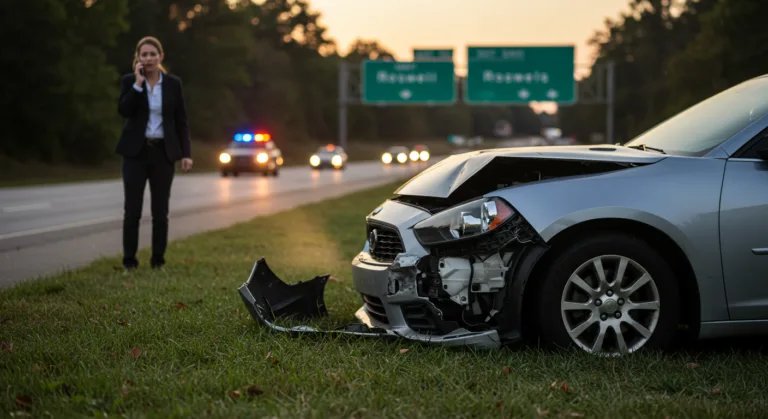
When a Grubhub driver gets t-boned in Columbus, the crash is just the beginning. The real fight is a legal one where proving your on-duty status becomes everything. There’s so much bad information out there about gig economy accidents, and it leaves injured drivers feeling like they have no options.
| Feature | Personal Auto Insurance | Grubhub Insurance (Typical) | Workers’ Compensation (Georgia) |
|---|---|---|---|
| Covers Commercial Use | ✗ No (often commercial use exclusions) | ✓ Yes (secondary/contingent) | ✗ No (generally exempt for contractors) |
| Covers Third-Party Bodily Injury | ✓ Yes | ✓ Yes | Partial (if employee status proven) |
| Covers Driver’s Own Vehicle Damage | ✓ Yes (if no commercial exclusion) | ✗ No (minimal or no coverage) | ✗ No (not typical benefit) |
| Covers Driver’s Medical Expenses | ✓ Yes (if no commercial exclusion) | ✗ No (minimal or no coverage) | Partial (if employee status proven) |
| Active During Phase 0 (Offline) | ✓ Yes (personal use) | ✗ No | ✗ No |
| Active During Phase 1 (Available) | ✗ No (commercial use exclusion risk) | Partial (limited/no liability) | ✗ No |
| Active During Phase 3 (Delivering) | ✗ No (commercial use exclusion risk) | ✓ Yes (most complete coverage) | Partial (if employee status proven) |
Myth 1: As a Grubhub Driver, You’re Always Covered by Grubhub’s Insurance
This is the most common and dangerous myth. Lots of drivers think that since they’re “working,” Grubhub’s insurance just kicks in automatically after a wreck. That’s almost never the whole story. The truth is messy and depends on how you’re classified and what part of the delivery you were in. Grubhub, like other delivery apps, calls its drivers independent contractors, not employees, and that classification is a huge deal for insurance. A 2023 report from the National Association of Insurance Commissioners (NAIC) confirms that most personal auto policies have “commercial use exclusions,” which means your own insurer can deny your claim if you were driving for work. Grubhub’s insurance is usually just a backup. It often only applies after your personal policy denies the claim, and it has strict limits. It might cover damage to the other car and their injuries, but it usually offers little to nothing for your own car or your medical bills. I see it all the time: drivers think they’re covered, then get hit with huge out-of-pocket costs because they didn’t understand how these policies actually work.
Myth 2: If the App is Open, You’re On-Duty and Covered
Just having the app open doesn’t guarantee you’re “on-duty” in the eyes of an insurance company. The exact moment of the crash is what counts. Grubhub’s coverage is broken down into phases:
Were you in a car accident?
Insurance adjusters are trained to settle fast and pay less. Most car accident victims leave an average of $32,000 on the table.
- Phase 0: Offline. You’re logged out. No Grubhub coverage. Period.
- Phase 1: Available. You’re logged in, waiting for an order. Grubhub provides little or no liability coverage here, and your own collision coverage is off the table.
- Phase 2: En Route to Pick Up. You’ve accepted an order and are driving to the restaurant. Grubhub’s liability coverage for others’ injuries and property damage usually applies now. Sometimes there’s limited collision coverage for your car.
- Phase 3: Delivering. You’ve got the food and are driving to the customer. This is where Grubhub’s coverage is strongest, typically including liability and some collision coverage (with a deductible).
A classic scenario is a driver who’s logged in but hasn’t accepted an order yet when they get hit. Their personal insurance denies the claim for commercial use, but Grubhub’s policy won’t activate because they weren’t on an active delivery. That’s a massive coverage gap. This is why you must grab screenshots of the app, complete with timestamps, the second you get into an accident near busy areas like Columbus Park Crossing or Peachtree Mall. If you don’t have that proof, showing which phase you were in becomes a serious fight.
Myth 3: You Can’t Claim Workers’ Compensation as a Gig Driver
People assume you can’t get workers’ compensation as a gig driver. It’s complicated, but not impossible. While Grubhub calls its drivers independent contractors to avoid paying for benefits like workers’ comp in Georgia, the law has some gray areas. The Georgia Workers’ Compensation Act, found in O.C.G.A. Section 34-9-1, defines an “employee” based on factors that could potentially apply to gig work. The State Board of Workers’ Compensation (SBWC) looks at who has control over the work, how payment is handled, and who provides the tools. Grubhub argues it has little control, but some courts have reclassified gig workers as employees based on how the app and payment systems really operate. (Frankly, the law is struggling to keep up with how the gig economy actually functions.) If you’re hurt in a Grubhub accident in Columbus, you need an attorney to evaluate your situation to see if a case for employee status can be built under Georgia law. It’s no guarantee, but it’s an option that must be looked at, especially with serious injuries when your other insurance isn’t paying.
Myth 4: If the Other Driver Was At Fault, Their Insurance Will Pay for Everything
Sure, if another driver is 100% at fault, their insurance is supposed to cover your damages. But for a Grubhub driver, it’s rarely that simple. A few things can go wrong. First, the at-fault driver could have no insurance or not enough. The Georgia Office of Insurance and Safety Fire Commissioner notes that plenty of drivers in Georgia have only the minimum liability coverage (or none at all), which won’t be enough to cover serious medical bills and lost wages. Your own uninsured/underinsured motorist (UM/UIM) coverage is supposed to help here, but again, your personal policy’s commercial use exclusion can become a major roadblock. Second, the other driver’s insurance company will fight you. They are in the business of minimizing payouts. They’ll try to argue you were partly at fault or that your injuries aren’t as bad as you say to reduce their payout. You’ll need solid documentation and sometimes expert testimony to prove the full value of your damages, especially lost future income from gig work. Having clear on-duty proof and accident details is non-negotiable here.
Myth 5: You Can Just Settle Directly with Grubhub’s Insurance
Trying to negotiate with Grubhub’s insurance carrier on your own is a huge mistake that almost always ends with you getting less money. The insurance adjuster’s job isn’t to help you. Their job is to save the company money. When you’re in a Grubhub accident in Columbus with real injuries, your claim’s value goes way beyond the first hospital bill to include lost income, future earnings, and your pain and suffering. An adjuster might throw a quick, lowball offer at you, hoping you’ll take it because you’re unrepresented and don’t know your rights. Don’t sign anything. An attorney who handles gig economy cases can figure out what your claim is actually worth, negotiate aggressively for you, and prepare to sue if the insurance company refuses to be fair. A lawyer will gather the evidence you need, like traffic cam footage from an intersection on Manchester Expressway, the Columbus Police Department report, and medical records, to build your case. They know the tactics insurers use to devalue claims and how to fight back, like proving future lost gig-work income or shutting down arguments about pre-existing conditions. The legal side of a Grubhub accident in Columbus presents a lot of traps, especially when it comes to proving your on-duty status and getting paid fairly. Knowing how to bust these common myths is the first step to protecting your rights and your finances. Don’t try to handle it alone. Atlanta car accidents demand close attention to the details, and that goes double for gig workers. For more on how these claims work, our discussion on Atlanta medical liens might be helpful, since dealing with medical bills is a huge part of recovering from a wreck.
What documents should I get right after a Grubhub wreck in Columbus?
Right after a Grubhub accident in Columbus, you need to get the other driver’s insurance and contact info, take pictures of the cars and the scene, and get contact info from any witnesses. Most important for you, take screenshots of your Grubhub app showing you’re on an active delivery, that means the order details, the restaurant/customer locations, and the exact time. Also make sure to get a copy of the police report from the Columbus Police Department.
How does Georgia law decide if a gig worker is an “employee” for workers’ comp?
Under Georgia law, specifically O.C.G.A. Section 34-9-1(2), the main test for an “employee” is how much control the company has over how the work gets done. It’s tricky for gig workers. The State Board of Workers’ Compensation looks at who provides the tools (your car), the payment method, and if the company can fire you for no reason. While companies classify you as an independent contractor, an attorney might be able to argue you’re an employee based on the specific facts of your job.
What do I do if Grubhub’s insurance denies my claim?
If Grubhub’s insurance denies you, your first call should be to a Georgia personal injury lawyer who knows gig economy cases. They can look at the denial letter, investigate your crash, and find other ways to get you paid. This could mean suing the at-fault driver, filing a claim with your own uninsured/underinsured motorist policy, or even fighting Grubhub’s classification of you as an independent contractor.
Can I still file a claim if I was partly at fault?
Yes. Georgia has a modified comparative negligence rule (O.C.G.A. Section 51-12-33). You can still get money as long as you are less than 50% at fault for the crash. Whatever percentage of fault is assigned to you will be deducted from your total payout. For instance, if you’re found to be 20% at fault, you can still collect 80% of your total damages.
What’s the right insurance for a Grubhub driver to have?
If you’re driving for Grubhub, you need a personal auto policy with a “rideshare endorsement” or “commercial use endorsement.” This coverage fills the gap between your personal driving and your gig work, so you’re not left uninsured. On top of that, get as much uninsured/underinsured motorist (UM/UIM) coverage as you can afford. It’s your best protection against other drivers who don’t have enough insurance.