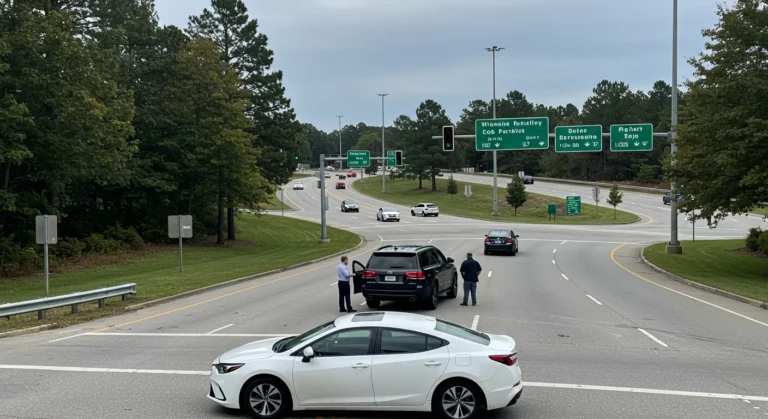
Being involved in a car accident in Columbus, Georgia can be a disorienting and stressful experience. Knowing the proper steps to take immediately following a collision can significantly impact your safety, your insurance claim, and any potential legal recourse. Do you know what to do before the police arrive?
Key Takeaways
- Immediately after a car accident in Columbus, Georgia, call 911 to report the incident and request medical assistance if needed.
- Exchange information with the other driver, including name, insurance details, and contact information, but avoid discussing fault.
- Document the scene by taking photos and videos of the damage to all vehicles involved, as well as the surrounding area, including any contributing factors like traffic signals or road conditions.
- Consult with a qualified Georgia car accident attorney to understand your legal rights and options for pursuing compensation for your injuries and damages.
Immediate Actions After a Car Accident
Your immediate actions following a car accident are critical. Prioritize safety, then follow a clear plan to protect yourself legally and financially. Here’s a step-by-step guide.
1. Ensure Safety First
The very first thing to do is assess the situation. Are you or anyone else injured? Is your vehicle in a dangerous location? If possible, move your car to a safe spot, like the shoulder of the road or a nearby parking lot. Turn on your hazard lights to alert other drivers. If you suspect serious injuries, do not attempt to move anyone. Wait for emergency responders.
2. Call 911
Georgia law requires you to report any accident involving injury, death, or property damage exceeding $500 to the police. Calling 911 ensures that law enforcement and medical personnel are dispatched to the scene. When speaking with the dispatcher, provide your location (be as specific as possible; intersections like Veterans Parkway and Manchester Expressway are helpful), the number of vehicles involved, and the nature of any injuries. A police report is crucial for your insurance claim and any potential legal action.
3. Exchange Information
Once the immediate safety concerns are addressed, exchange information with the other driver(s). This includes:
- Full name
- Address
- Phone number
- Insurance company name and policy number
- Driver’s license number
- Vehicle registration information
Do not discuss fault. Stick to providing factual information. Anything you say can be used against you later. I had a client a few years back who, out of shock, apologized profusely at the scene, even though the other driver ran a red light. That apology complicated her case significantly.
4. Document the Scene
If you are able, gather evidence at the scene. Use your smartphone to take photos and videos of:
- Damage to all vehicles involved
- License plates of all vehicles
- The accident scene, including road conditions, traffic signals, and any visible contributing factors
- Any visible injuries
Also, note the date, time, and location of the accident. If there are witnesses, get their names and contact information. Their testimony can be invaluable.
5. Seek Medical Attention
Even if you feel fine immediately after the accident, it’s essential to seek medical attention. Some injuries, such as whiplash or concussions, may not manifest symptoms for hours or even days. A medical professional can properly diagnose and treat any injuries, and their report will serve as important documentation for your insurance claim. Consider being evaluated at Piedmont Columbus Regional Midtown or St. Francis-Emory Healthcare.
What Not To Do After a Car Accident
Knowing what not to do is just as important as knowing what steps to take. Here’s where people often go wrong:
1. Admitting Fault
As mentioned earlier, never admit fault, even if you think you might be partially responsible. The police investigation and insurance company will determine fault based on the evidence. An off-the-cuff apology can be misconstrued and used against you.
2. Failing to Call the Police
Some people try to handle minor accidents privately to avoid involving insurance companies. This is a risky move. Without a police report, it’s difficult to prove the other driver was at fault if they later deny responsibility. Plus, as stated previously, Georgia law requires reporting accidents that meet certain criteria. Don’t skip this step.
3. Delaying Medical Treatment
Putting off medical treatment can not only jeopardize your health but also weaken your legal claim. Insurance companies often argue that if you didn’t seek immediate medical attention, your injuries must not be that serious. I’ve seen adjusters deny claims outright based on this argument. Don’t give them the opportunity.
4. Communicating Directly with the Other Driver’s Insurance Company
The other driver’s insurance company is not on your side. Their goal is to minimize their payout. Avoid giving them a recorded statement or providing any information about the accident without first consulting with an attorney. Anything you say can be used to undermine your claim.
| Feature | Option A: Immediate Actions | Option B: Document Everything | Option C: Contact a Lawyer |
|---|---|---|---|
| Assess Injuries | ✓ Yes Check yourself, then others for injuries immediately. |
✗ No Documentation comes after safety. |
✗ No Lawyer contact is secondary to immediate needs. |
| Secure the Scene | ✓ Yes Move vehicles if safe, turn on hazards. Prevent further accidents. |
✗ No Focus is on recording, not scene management. |
✗ No Not a lawyer’s immediate responsibility. |
| Exchange Info | ✓ Yes Driver’s license, insurance info, registration. |
✓ Yes Crucial for accurate record-keeping. |
✗ No Lawyer can assist later, not at the scene. |
| Photo/Video Evidence | Partial Quick photos only. Safety first. |
✓ Yes Capture photos of damage, location, and surroundings. |
✗ No Lawyer not present at the scene. |
| Witness Information | Partial Gather names, numbers quickly. |
✓ Yes Obtain statements and contact details carefully. |
✗ No Lawyer gathers info later. |
| Admit Fault | ✗ No Never admit fault at the scene. |
✗ No Avoid speculation, just record facts. |
✗ No Defer to legal counsel on liability. |
| Contact Police | ✓ Yes Report the accident to authorities immediately. |
✓ Yes Document police arrival and interaction. |
Partial Lawyer may advise on reporting details. |
The Role of a Car Accident Lawyer
Navigating the aftermath of a car accident can be complex, especially when injuries are involved. A car accident lawyer in Columbus can provide invaluable assistance in protecting your rights and pursuing fair compensation.
If you’ve been injured in a Columbus car accident, knowing your rights is crucial.
1. Investigating the Accident
A lawyer can conduct a thorough investigation of the accident to determine liability. This may involve reviewing the police report, interviewing witnesses, analyzing the accident scene, and consulting with accident reconstruction experts. They can also obtain and preserve evidence that might otherwise be lost or destroyed.
2. Dealing with Insurance Companies
Insurance companies are notorious for trying to lowball settlements or deny claims altogether. A lawyer can act as your advocate and negotiate with the insurance company on your behalf. They understand the tactics insurance companies use and can effectively counter them. They can also ensure that you are not taken advantage of.
3. Assessing Damages
A lawyer can help you assess the full extent of your damages, including:
- Medical expenses (past and future)
- Lost wages (past and future)
- Property damage
- Pain and suffering
- Emotional distress
- Loss of enjoyment of life
They can also help you gather the necessary documentation to support your claim. I had a case last year where my client didn’t realize she was entitled to compensation for diminished value of her vehicle after it was repaired. We were able to recover an additional $3,000 for her based on that.
4. Filing a Lawsuit
If the insurance company refuses to offer a fair settlement, a lawyer can file a lawsuit on your behalf. This is a serious step, but it may be necessary to protect your rights. A lawyer can guide you through the litigation process and represent you in court. In Georgia, the statute of limitations for personal injury cases is generally two years from the date of the accident (O.C.G.A. Section 9-3-33). Missing this deadline means you lose your right to sue.
5. Providing Peace of Mind
Dealing with the aftermath of a car accident can be incredibly stressful. A lawyer can take the burden off your shoulders and handle all the legal aspects of your case. This allows you to focus on recovering from your injuries and getting your life back on track. It’s hard to put a price on that peace of mind.
Case Study: The Intersection of Wynnton Road and I-185
Let’s consider a hypothetical, but realistic, case. Imagine a driver, Sarah, is traveling south on Wynnton Road in Columbus and is struck by another vehicle that ran a red light while exiting I-185. Sarah sustains whiplash and minor injuries to her knee. Her car suffers significant front-end damage.
Here’s how a lawyer could help:
- Investigation: The lawyer would obtain the police report, which confirms the other driver was cited for running a red light. They would also interview any witnesses to corroborate Sarah’s account.
- Medical Bills: Sarah’s medical bills total $5,000. The lawyer would ensure that all medical records and bills are properly documented and submitted to the insurance company.
- Lost Wages: Sarah misses two weeks of work due to her injuries, resulting in $2,000 in lost wages. The lawyer would obtain pay stubs and a letter from Sarah’s employer to verify her lost income.
- Negotiation: The lawyer would negotiate with the insurance company to recover Sarah’s medical expenses, lost wages, property damage, and pain and suffering.
- Settlement: After several rounds of negotiation, the lawyer secures a settlement of $15,000 for Sarah, covering all her damages.
Without a lawyer, Sarah might have accepted a much lower settlement offer from the insurance company, potentially leaving her with unpaid medical bills and inadequate compensation for her pain and suffering.
Choosing the Right Car Accident Lawyer
Selecting the right attorney can make all the difference. Look for a lawyer with:
- Experience: Choose a lawyer who has a proven track record of success in handling car accident cases in Columbus, Georgia.
- Reputation: Read online reviews and ask for referrals from friends or family.
- Communication: Find a lawyer who is responsive, communicative, and willing to explain the legal process in clear, understandable terms.
- Resources: Ensure the lawyer has the resources necessary to investigate your case thoroughly and fight for your rights.
Many lawyers, including my firm, offer free consultations. Take advantage of this opportunity to meet with several attorneys and find one who is a good fit for you.
Remember, the aftermath of a car accident in Columbus, Georgia can be overwhelming. But by taking the right steps and seeking the help of a qualified attorney, you can protect your rights and pursue the compensation you deserve. Don’t wait. The sooner you act, the better your chances of a successful outcome.
If you’re unsure about losing your right to sue, it’s best to consult with a lawyer.
Remember to act fast to protect your rights after a car accident.
What should I do if the other driver doesn’t have insurance?
If the other driver is uninsured, you may be able to file a claim under your own uninsured motorist (UM) coverage. UM coverage protects you if you are injured by an uninsured driver. It’s important to report the accident to your insurance company and consult with an attorney to understand your options.
How long do I have to file a car accident claim in Georgia?
In Georgia, the statute of limitations for personal injury cases is generally two years from the date of the accident (O.C.G.A. Section 9-3-33). This means you have two years to file a lawsuit. However, it’s best to consult with an attorney as soon as possible after the accident to ensure that you don’t miss any deadlines.
What if I was partially at fault for the accident?
Georgia follows a modified comparative negligence rule. This means that you can still recover damages even if you were partially at fault, as long as your percentage of fault is less than 50%. However, your damages will be reduced by your percentage of fault. For example, if you were 20% at fault and your damages were $10,000, you would only be able to recover $8,000.
What types of damages can I recover in a car accident case?
You can recover various types of damages, including medical expenses (past and future), lost wages (past and future), property damage, pain and suffering, emotional distress, and loss of enjoyment of life. In some cases, you may also be able to recover punitive damages if the other driver’s conduct was particularly egregious.
How much does it cost to hire a car accident lawyer?
Most car accident lawyers work on a contingency fee basis. This means that you don’t pay any attorney fees unless they recover compensation for you. The attorney fee is typically a percentage of the settlement or judgment, usually around 33% to 40%. It is important to discuss the fee arrangement with the attorney upfront.
The single most important thing you can do after a car accident in Columbus is consult with an attorney. Even if you think your case is straightforward, a lawyer can help you navigate the complexities of the legal system and ensure that you receive fair compensation for your injuries and damages. Contact a qualified Georgia car accident lawyer today to discuss your case.